What are tax scams?
Tax scams are fraudulent schemes targeting taxpayers, tricking them into giving away money, personal information, or tax-related credentials by posing as the IRS, state tax agencies, tax preparers, or tax relief companies. These scams can happen before, during, or after you file your return. Scammers may reach you through phone calls, text messages, emails, fake websites, social media posts, or even mailed notices.
The IRS annual Dirty Dozen campaign warns taxpayers that tax-related scams occur year-round, but they become especially common during tax season.2
Why tax scams spike during tax season
Tax scams become common between January and April because millions of people are filing returns, expecting refunds, and communicating with tax professionals. During this busy period, scammers take advantage of tight deadlines and financial stress by sending messages with an urgent tone claiming there’s a problem with your return or that you’re owed money.
But the risk doesn’t end when tax season does. Post-season tax scammers target taxpayers who are waiting for refunds, responding to IRS notices, requesting filing extensions, or resolving tax issues months later. Criminals also use the months after filing season to exploit stolen personal data, leveraging breached income tax records to commit further fraud.
Are tax impersonation scams increasing?
Yes, tax impersonation scams have grown more sophisticated in recent years, and scam tactics continue to evolve each filing season. The IRS’s 2026 Dirty Dozen list shows how fast these tactics shift.
New entries include AI-enabled phone impersonation, which uses voice mimicry and spoofed caller ID, and fraudulent Form 2439 filings designed to trigger fake tax refunds.3 As IRS Chief Executive Officer Frank J. Bisignano put it, “Thieves continuously adjust the pitches they use to take advantage of honest taxpayers.”3
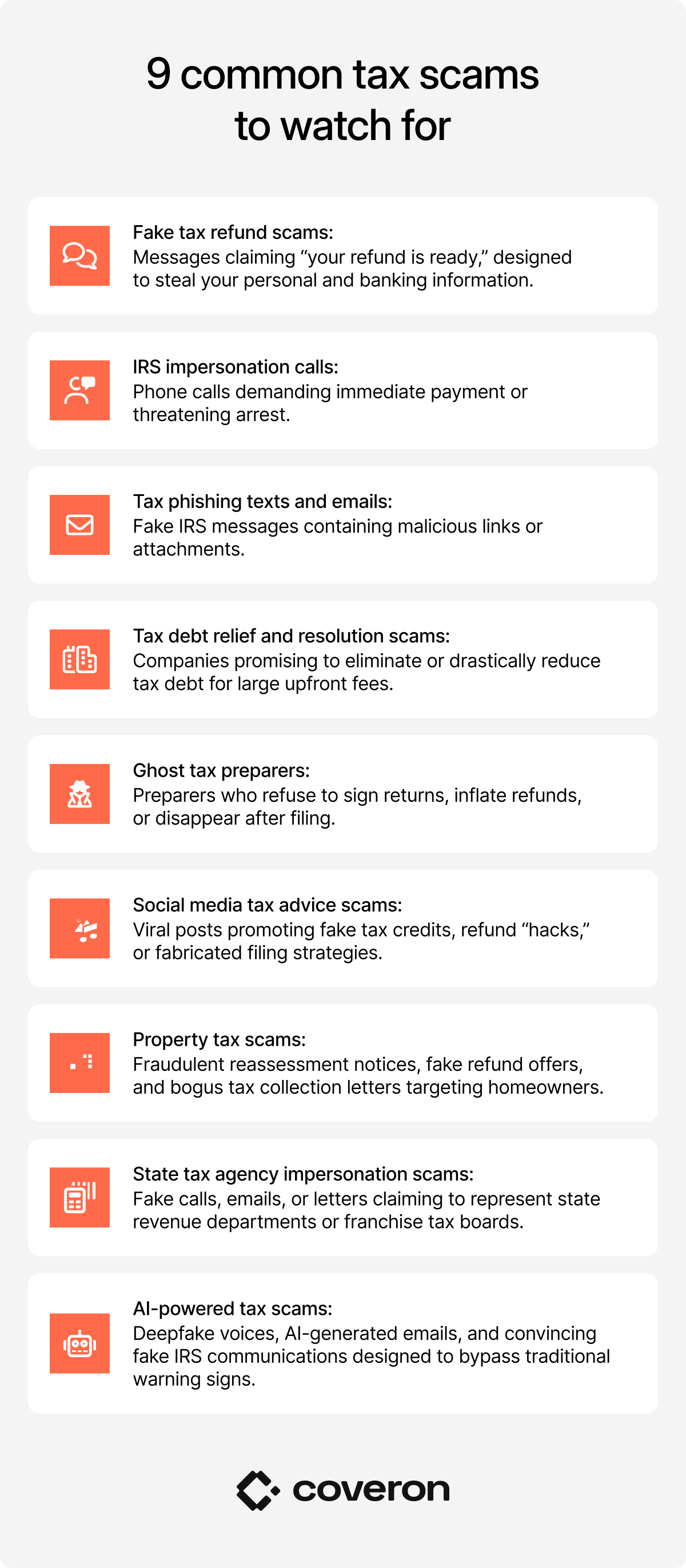
9 common tax scams
Tax season scams range from fake refund messages and threatening calls to dishonest preparers and misleading tax advice. While the approach may change, the goal is usually to steal money, account credentials, or personal information. Below are nine popular tax scams to watch out for this filing season.
1. Tax refund scams
In a tax refund scam, a message claims your refund is ready, delayed, or needs verification. The message may contain a link designed to collect your Social Security number, bank details, or login credentials. Some scammers also mail fake refund checks or official-looking notices, asking you to call a number or verify details to “release” the funds — a tactic meant to steal information over the phone instead of through a link.
How to spot them: Look for unexpected refund texts, requests for a processing fee, or links asking you to confirm sensitive information. The IRS doesn’t initiate contact by text, email, or social media to request your personal information — the FTC confirms that neither the real IRS nor state tax offices reach out this way.4
How to avoid them: Check your refund through the official IRS website instead of using links in messages, as these often lead to fake sites that are convincing by design. “Phishing links used in refund scams are built to mirror the real IRS refund tracker down to the layout and color scheme,” says Tomas Sinicki, Managing Director at Coveron. “The only real tell is the web address itself, so typing the IRS site directly into your browser is safer than trusting any link in a text or email.”
PRO TIP
Review our guide on how to spot a phishing email before responding.
2. IRS impersonation calls
Tax call scams or IRS tax scams often begin with a robocall or live caller claiming that you owe back taxes or have ignored an urgent IRS notice. In reality, the IRS generally initiates contact by regular mail, not by unsolicited phone calls.
The caller may threaten arrest, deportation, or wage garnishment unless you pay or provide personal information right away, and they may use official-sounding names or spoof caller ID to make the call appear legitimate. “Caller ID spoofing works because people still trust the number on their screen more than the message itself,” says Sinicki. “A scammer can make a call appear to come from the IRS’s real number in Washington.”
How to spot them: Pay attention to threats, spoofed caller ID, or demands for payment by gift card, cryptocurrency, wire transfer, or prepaid card.
How to avoid them: Hang up and dial the IRS directly using the number listed on irs.gov opens in a new tab, not the one given by the caller. Review how other common phone scams work.
PRO TIP
Scams targeting seniors often take the form of IRS impersonation calls, since callers assume older adults receive government benefits or have retirement savings worth pursuing. If an elderly family member gets a threatening call demanding immediate payment to avoid arrest or deportation, encourage them to hang up without engaging.
3. Phishing texts and emails
Fake IRS texts and emails often look like official notices, using IRS branding and language with an urgent tone. Common claims include a rejected return, an account problem, or a refund waiting to be released. Links and attachments can lead to fraudulent websites or malware.
How to spot them: Watch for unsolicited contact, pressuring or alarming wording, misspelled domains, shortened links, suspicious attachments, or requests for passwords and personal data.
OUR EXPERT SAYS
“The old advice to watch for typos and broken English is losing its usefulness,” says Sinicki. “AI writing tools help scammers produce clean, error-free messages, so the content of a message matters less than whether you were expecting it at all.”
How to avoid them: Don’t click links, reply to messages, or open attachments. Review the signs of smishing text scams and verify the message through an official government website.
4. Tax debt relief scams
Tax debt relief scams, sometimes called tax resolution scams, target people who owe taxes or fear they may face collection action. This type of tax scam involves promises to settle the debt for “pennies on the dollar,” stop penalties, or guarantee approval into a debt forgiveness program, such as the IRS Offer in Compromise.
Scammers may operate under names such as “Tax Relief Group,” “Tax Review Unit,” “US Tax Consultants,” “American Tax Benefits,” or “United Tax Consultants” to appear affiliated with the government. They claim to have insider access and demand a large upfront fee before reviewing the person’s financial situation.
How to spot them: Watch for “pennies on the dollar” claims, guaranteed qualification, rushed payment demands, or vague explanations of fees and services.
How to avoid them: Research the company independently and review written terms before paying. The IRS Offer in Compromise is a legitimate program for eligible taxpayers and can be applied for directly through the IRS. No tax relief company can guarantee that you’ll qualify or be approved.
5. Ghost preparers and dishonest tax preparers
Ghost preparers complete returns but refuse to sign them or provide a Preparer Tax Identification Number (PTIN). Some false tax preparers also invent deductions or credits to inflate a refund.
How to spot them: Watch for immediate cash payment requests, charges based on refund size, blank tax forms, missing signatures, or requests to send your refund to the preparer’s account.
How to avoid them: Check the preparer’s credentials, review the full return, and confirm that all income, credits, and banking details are accurate before filing.
6. Social media tax advice scams
Viral posts and videos may promote “tax hacks” that encourage people to invent income or withholding, list fictional employers, or claim credits they don’t qualify for. Following this advice can lead to delayed or denied refunds, repayment demands, audits, and penalties. The IRS continues to identify misleading tax advice on social media as a major tax-season threat. The false advice may involve:
- Fake credit schemes. Promoters may claim that nearly everyone qualifies for the Fuel Tax Credit or the “Self-Employment Tax Credit,” as they often call it. In reality, the Fuel Tax Credit applies only to specific business uses of fuel, while the broadly promoted “Self-Employment Tax Credit” doesn’t exist as advertised.
- ERC tax credit scams. Employee Retention Credit mills target businesses with claims that eligibility can be confirmed in minutes or that every employer qualifies. Although the ERC is legitimate, eligibility is limited, and businesses that submit improper claims may have to repay the credit with interest and penalties.
How to spot them: Watch for promises of guaranteed refunds, “hidden” credits, instructions to fabricate tax information, rushed filing, large upfront charges, or fees based on a percentage of the expected credit.
How to avoid them: Verify any unfamiliar credit through IRS guidance or a qualified tax professional. Don’t submit a claim until you understand the eligibility rules and can support it with accurate records.
7. Property tax scams
Property tax scams involve criminals impersonating local tax authorities to send you fake tax bills, reassessment notices, delinquency warnings, or overpayment refund offers. Public property records can make these scams appear convincing, since scammers often include accurate details like your address or parcel number.
How to spot them: Watch for incorrect parcel details, unusual payment methods, urgent threats, or fees for services available directly from local authorities.
How to avoid them: Contact your county assessor or tax collector using information from its official website, not the suspicious notice.
8. Franchise Tax Board and state tax agency scams
Scammers may impersonate tax agents of your state’s tax authority — such as California’s Franchise Tax Board — through phone calls, letters, emails, or text messages, claiming that you owe state taxes, qualify for a refund, or need to verify your identity.
How to spot them: Watch for unfamiliar email addresses, vague agency names, suspicious links, or demands for immediate payment.
How to avoid them: Visit your state tax agency’s official website directly and confirm the notice using publicly listed contact details.
9. AI tax scams
AI deepfake tax scams use polished emails, realistic robocalls, cloned voices, and altered images or documents to make impersonation harder to detect. Scammers may use these tools to pose as IRS agents, tax preparers, employers, or even someone the target knows and then create a sense of urgency around an unpaid balance, a delayed refund, or an account problem. Because the message may sound natural and contain few obvious errors, recipients should verify the request independently rather than relying on appearance, voice, or caller ID alone.
How to spot them: Watch for a convincing caller who demands urgent payment, refuses to provide written proof, or asks for passwords and verification codes.
How to avoid them: Don’t rely on voice, grammar, or caller ID alone. Verify the request independently.
OUR EXPERT SAYS
“Voice cloning tools now need only a few seconds of audio pulled from a voicemail greeting or a social media video to produce a convincing clone,” says Sinicki. “That’s why a shaky or urgent-sounding voice on the phone shouldn’t be treated as proof of anything.”
Tax scam red flags to watch for
Whether a scam arrives by phone, text, email, or mail, most share the same underlying warning signs. Scammers often rely on urgency and unusual requests to catch targets off guard. The following red flags can help you separate legitimate tax communications from fraudulent ones:
Demands for unusual payment methods
Scammers often insist on payment by gift cards, wire transfers, or cryptocurrency because these methods are difficult to trace or reverse. The IRS doesn’t require taxpayers to use these payment methods to resolve tax issues.
Threats and urgency
Be suspicious of anyone threatening immediate arrest, deportation, lawsuits, license suspension, or wage garnishment unless you pay immediately. Scammers may also discourage you from asking questions or appealing the claim.
PRO TIP
If a message pressures you to act immediately, treat that urgency as the biggest red flag. The IRS gives taxpayers time to verify information, ask questions, and appeal when appropriate.
Requests for personal or financial information
Unprompted requests for your Social Security number, PIN, passwords, online account credentials, or bank account information should raise concern.
Suspicious links and misspelled domains
Fraudulent messages often contain shortened links, lookalike website addresses, or misspelled domains that imitate government websites.
How to know it’s really the IRS contacting you
The IRS generally makes first contact by mail, never demands immediate payment by gift card or cryptocurrency, and never threatens to involve the police.
When in doubt, ask for the caller’s name, department, and notice or case reference number. Then call the IRS using a number listed on irs.gov or in a verified letter, not the number provided by the caller. You can also check your IRS online account or learn more about how the IRS verifies your identity. The table below can help you gauge the legitimacy of the contact:
| Behavior | IRS | Phony IRS agent |
|---|---|---|
First contact | Usually sends a formal letter | Calls, texts, emails, or DMs unexpectedly |
Phone calls | May call after sending a notice | Calls without prior notice and creates a sense of urgency |
Payment | Uses official IRS payment options6 | Demands gift cards, wire transfers, or cryptocurrency |
Threats | Provides notice and appeal rights | Threatens arrest, deportation, or police action |
Personal information | Uses secure verification procedures via the ID.me service | Asks for passwords, PINs, or full account details unprompted |
Verification | Lets you confirm the contact independently | Pressures you to stay on the line |
What to do if you’ve been targeted by a tax scam
If you’ve encountered a tax scam, stop communicating with the sender and preserve any emails, texts, phone numbers, receipts, or payment records. Report the incident through the official channels below first, then consider monitoring or recovery support — such as Coveron’s services — to help catch any lasting damage.
Report the scam to the IRS and FTC
Use the reporting option that best matches what happened. More than one may apply, so save the original message, phone number, payment receipt, and other evidence before deleting or blocking anything.
- Phishing. Don’t reply, click links, or open attachments. Send suspicious tax emails to [email protected], preferably as an attachment so the IRS receives the original technical details. For a text, include the sender’s number, the message, and when it was received.
- Fraudulent tax return. Follow the instructions in any identity verification letter from the IRS. If someone filed a return using your information, submit Form 14039 (Identity Theft Affidavit) when the IRS directs you to or when its guidance says the form applies. Don’t submit another form for the same incident if you’ve already filed one.
- IRS impersonation. Report callers pretending to represent the IRS to the Treasury Inspector General for Tax Administration (TIGTA). Provide details such as the phone number, date and time of the call, what the caller claimed, and how they asked you to pay. TIGTA also provides a phone hotline for reporting these calls.
- Consumer fraud. File a report at reportfraud.ftc.gov if you encountered a scam, sent money to a fraudster, or dealt with a dishonest business. Include the amount and payment method used, the scammer’s contact details, and a brief account of what happened. FTC reports help investigators identify patterns and build cases.
- Identity theft. Report the incident at identitytheft.gov if your Social Security number, tax documents, or other personal information was stolen or misused. The site can create an FTC Identity Theft Report and a personalized recovery plan with steps and sample letters for addressing the damage.
PRO TIP
See Coveron’s guide on how to report identity theft for more on documenting the incident and starting the recovery process.
Place a fraud alert or freeze your credit
A fraud alert asks lenders and creditors to take additional steps to confirm your identity before approving new credit in your name. You only need to place the alert with one of the three major credit bureaus (Equifax, Experian, or TransUnion) because they notify one another.
A credit freeze offers stronger protection than a fraud alert by restricting who can view your credit reports. This can make it more difficult for identity thieves to open credit cards, loans, or other accounts using your information. Unlike a fraud alert, you must contact Equifax, Experian, and TransUnion separately to place or remove a freeze with each bureau.
Neither measure can prevent every form of fraud, especially if the misuse involves existing accounts, tax returns, or stolen medical information. However, both can reduce the risk of criminals opening new credit accounts in your name after your Social Security number or other sensitive information has been exposed.
PRO TIP
Learn how to freeze your credit and when it may be an appropriate step.
Monitor your identity for downstream misuse
Stolen tax documents, including Form W-2, may expose your Social Security number, income, employer details, and address — information that can fuel tax identity theft or other fraud. Learn what someone can do with your Social Security number once it’s exposed.
A service like Coveron offers credit monitoring that alerts you to activity such as new accounts and inquiries. Its dark web monitoring checks for exposed personal information across known leak sources, while identity theft recovery provides support if misuse occurs. These services don’t replace official reports, credit freezes, or direct action with affected organizations, but they offer additional protection and support.
How to avoid tax scams
The following measures can reduce your exposure and help you catch suspicious activity sooner, though no single step guarantees full protection:
Enroll in an IRS Identity Protection PIN
An IP PIN is a six-digit number that helps stop someone from filing a federal return using your Social Security number or Individual Taxpayer Identification Number. The IRS issues a new IRS IP PIN each year, and anyone who can verify their identity may opt in.
File early to beat fraudsters
File tax returns as soon as you’ve received all the documents needed to prepare an accurate return. Once the IRS accepts your legitimate return, a criminal who later tries to file using the same Social Security number is more likely to encounter a duplicate-filing rejection.
Filing early doesn’t guarantee protection, but it narrows the time available for someone else to file first. That matters because tax identity theft can take a long time to resolve. For example, in 2025, hundreds of thousands of affected taxpayers were waiting an average of more than 21 months for the IRS to complete their cases and release delayed refunds.5
Verify preparers and communications
Paid federal tax preparers must have a valid PTIN and sign the returns they prepare. Review the completed return before signing, confirm that the refund account belongs to you, and never sign a blank form.
When it comes to unexpected IRS or state tax communications, verify those independently. Use an official website, online account, or phone number rather than the contact details in the message.
Watch for AI-driven tax scams
AI can help scammers create convincing phishing messages, cloned voices, robocalls, and spoofed caller IDs. The IRS included AI-enabled phone impersonation in its 2026 Dirty Dozen list, so polished language or a realistic voice shouldn’t be treated as proof that a message is genuine.3 Learn more about how AI scams work to protect yourself.
Remain vigilant
Don’t click unexpected links or open unfamiliar attachments. If you receive a suspicious IRS call, hang up and verify the issue independently. Never provide passwords, one-time codes, or financial information to an unexpected caller.
OUR EXPERT SAYS
“A child’s Social Security number can sit unused for a decade before anyone notices it’s being used to file fraudulent tax returns,” says Sinicki. “Parents should treat their kids’ SSNs with the same caution as their own, because the damage often surfaces right when that child applies for a first credit card or student loan.”
FAQ
References
1 Federal Trade Commission. (2026, June 15). FTC Data Show People Reported Losing $3.5 Billion to Imposter Scams in 2025. FTC. https://www.ftc.gov/news-events/news/press-releases/2026/06/ftc-data-show-people-reported-losing-3-point-5-billion-imposter-scams-2025 opens in a new tab
2 Internal Revenue Service. (2026, March 9). Dirty Dozen. IRS. https://www.irs.gov/newsroom/dirty-dozen opens in a new tab
3 Internal Revenue Service. (2026, March 5). Dirty Dozen tax scams for 2026: IRS reminds taxpayers to watch out for dangerous threats. IRS. https://www.irs.gov/newsroom/dirty-dozen-tax-scams-for-2026-irs-reminds-taxpayers-to-watch-out-for-dangerous-threats opens in a new tab
4 BCP Staff. (2026, January 22). That text or email about your “tax refund” is a scam. Federal Trade Commission. https://consumer.ftc.gov/consumer-alerts/2026/01/text-or-email-about-your-tax-refund-scam opens in a new tab
5 Robert J. Fedor, Esq., L.L.C. (2026, April 9). Taxpayer Advocate Report: Audits and Offers in Compromise. https://www.fedortax.com/blog/taxpayer-advocate-report-audits-and-offers-in-compromise opens in a new tab
6 Internal Revenue Service. (2026, June 26). Payments. IRS.