Warning signs your bank account number has been compromised
Bank account information can be misused without immediately triggering an obvious warning. Monitoring your account activity, security notifications, and communications from your bank can help you spot suspicious activity early.
Unexplained debits or discrepancies in your bank statements
Review your bank statements and transaction history regularly. Unauthorized withdrawals, unfamiliar electronic payments, or even small charges you don’t recognize may indicate that someone is testing whether your account details can be used successfully.
If you notice a transaction you didn’t authorize, contact your bank as soon as possible rather than waiting to see whether additional charges appear.
Suspicious phone calls or messages asking for personal details or passwords
Be wary of unexpected phone calls, texts, or emails claiming to come from your bank or credit union. Common phone scams involve fraudsters warning that your account is at risk and then asking you to “verify” sensitive information, such as your online banking password, PIN, or a one-time verification code.
Legitimate financial institutions won’t ask for your full password over the phone. If someone claiming to represent your bank pressures you to share confidential information, end the conversation and contact the bank through its official website, app, or phone number.
Alerts of logins or new payees you didn’t authorize
Security alerts for actions you didn’t take can indicate that someone is trying to gain access to your account or has already succeeded. Pay attention to notifications about:
- Logins from unfamiliar devices or locations.
- New payment recipients or payees.
- Changes to your contact information.
- Password or security-setting changes.
You should also investigate if expected banking alerts suddenly stop arriving. Someone with access to your account may have changed your notification settings.
What someone can actually do with your bank account and routing numbers
Your bank account and routing numbers are commonly used for legitimate payments and transfers. What happens if someone has your bank account number depends largely on what other information they have. If a scammer obtains both your account and routing numbers, they may be able to misuse them for unauthorized transactions or combine them with other stolen information to commit financial fraud.
They can set up unauthorized withdrawals and ACH payments
With both your bank account and routing numbers, a scammer may attempt to initiate unauthorized automated clearing house (ACH) payments — electronic transfers between bank accounts — or withdrawals from your account.
For example, they could use your details to pay for services, make purchases, or transfer money if the payment provider doesn’t require additional verification. Whether a transaction succeeds depends on the safeguards used by your bank and the organization processing the payment.
They can create counterfeit or fake checks
If someone has both your bank account and routing numbers, they can use that information to create counterfeit checks that appear to come from your account.
A scammer could then try to cash the fake check, use it to pay for goods or services, or deposit it through a mobile banking app. If the check is processed successfully, the money may be withdrawn from your real account.
This type of fraud can be especially difficult to spot if you don’t regularly review your transaction history, so investigate unfamiliar check payments as soon as possible.
They can facilitate wire transfer fraud
Knowing your bank account and routing numbers alone usually isn’t enough to initiate a wire transfer because banks typically require additional identity verification or authentication. However, scammers may combine these details with other stolen information or use social engineering to impersonate you and try to authorize a transfer.
Example: A scammer could contact your bank while pretending to be you, provide information they already know about your account, and attempt to convince a representative to approve a fraudulent transfer.
The FTC reported about $16 billion in total fraud losses in 2025, the highest amount on record.
Imposter scams alone accounted for $3.5 billion in reported losses, while bank impersonation scams caused the highest losses among business impersonation scams.[1]
They can launder money through your account
A scammer may also try to use your bank account to move fraudulently obtained money. For example, they could deposit funds into your account and then attempt to have the money transferred elsewhere, making your account part of a money-laundering scheme.
If you notice an unexpected deposit from an unknown source, don’t spend or transfer the money. Contact your bank and request an investigation of the transaction. Moving the funds yourself could complicate the situation, especially if the money is linked to fraud or other criminal activity.
They can commit identity theft and open new accounts
Your bank account information can also play a role in broader identity theft schemes. An account and routing number alone usually aren’t enough to steal your identity, but scammers may combine them with other personal information, such as your name, Social Security number, or driver’s license details, to impersonate you.
With enough information, they may attempt to open credit cards, loans, bank accounts, or other financial accounts in your name. According to the Identity Theft Resource Center’s 2026 Trends in Identity Report, 62.1% of attempted identity misuse cases reported to the organization involved new account applications.[2]
Example: A scammer who already has your banking and personal information could use those details as part of a fraudulent credit card or loan application.
| Information exposed | What someone may be able to do | Risk |
|---|---|---|
Just a routing number | Identify your financial institution, but generally do little with it alone. | Low |
Just a bank account number | Use it in scams or combine it with other stolen information. | Low to moderate |
Just a checking account number | Similar to a bank account number — limited use alone, but potentially useful alongside other personal data. | Low to moderate |
Account and routing numbers | Attempt ACH fraud, create counterfeit checks, or use the details in broader financial fraud. | Higher |
What someone cannot do with just your bank account and routing numbers
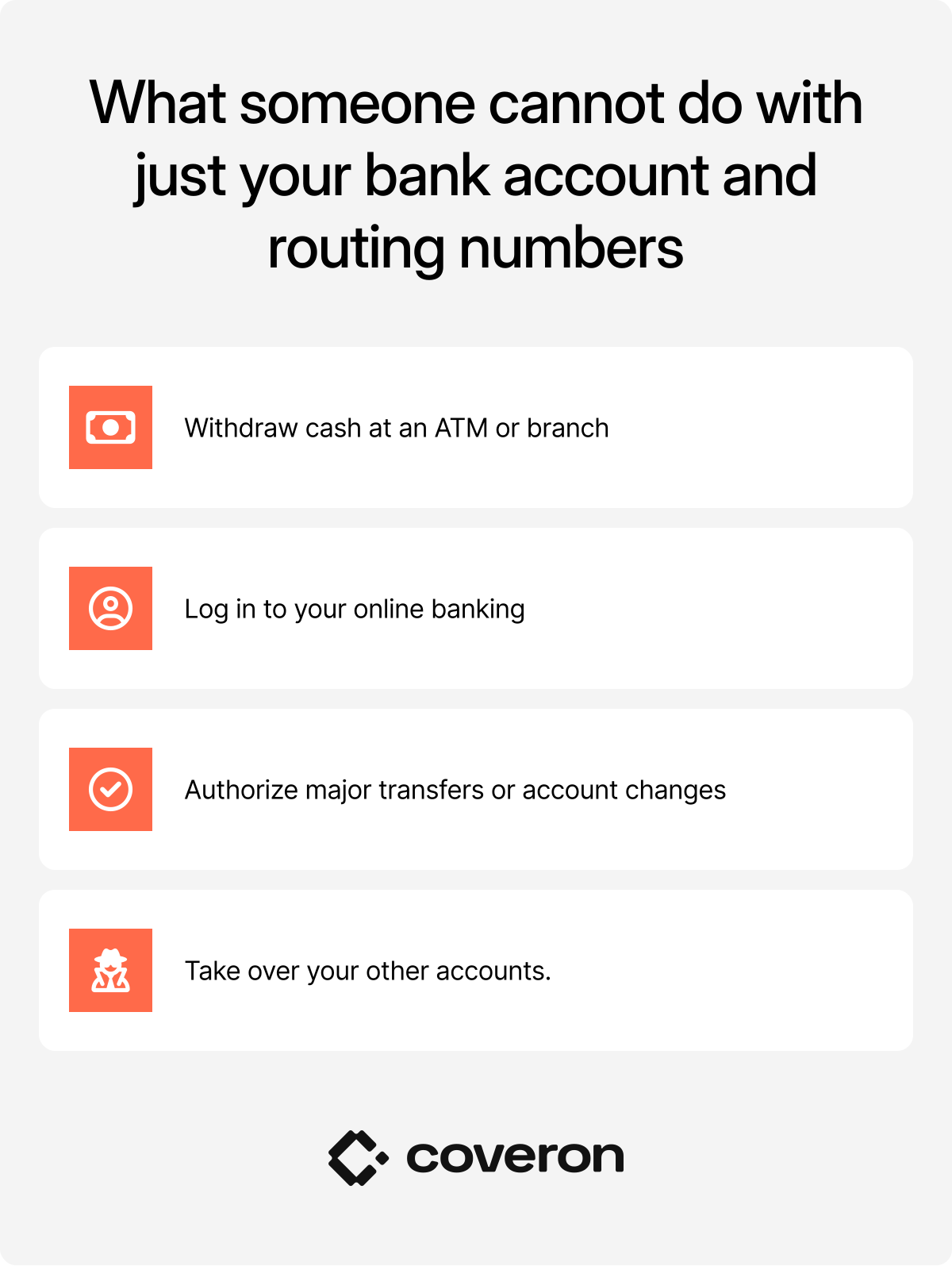
Having your bank account and routing numbers can create opportunities for fraud, but these details alone generally aren’t enough to give someone full control over your bank account.
They can’t instantly clean out your account at an ATM or bank branch
Your bank account and routing numbers alone aren’t enough to withdraw cash from an ATM or bank branch. An ATM withdrawal typically requires your physical debit card and PIN, while an in-person withdrawal requires additional identity verification.
A scammer would therefore need more than your account and routing numbers to withdraw money directly in person.
They can’t directly log in to your online banking
If you’re wondering whether someone can hack your bank account with your account number alone, the answer is generally no. Your account and routing numbers are separate from the credentials used to access your online banking. A scammer would typically also need information such as your username, password, or authentication codes to sign in.
If you’re wondering whether your online banking is safe, protecting your login credentials and devices is just as important as keeping your banking details secure.
They can’t authorize major transfers or changes without verification
Major account actions generally require additional verification beyond your account and routing numbers. For example, a bank may require a one-time passcode, identity check, or confirmation before approving a wire transfer, changing account details, or linking a new payee.
These safeguards mean that having your account and routing numbers alone generally isn’t enough to make major changes or take full control of your account.
They can’t simply take over other accounts
Your bank account and routing numbers don’t automatically give someone access to your credit cards, investment accounts, email, or other services. Those accounts have their own login credentials and security checks.
However, scammers can still use exposed banking information as part of an identity theft attempt if they also obtain other personal information about you.
How can someone get your bank account and routing numbers?
Scammers can obtain your banking information in several ways, from phishing and stolen checks to data breaches and malware. Knowing how these methods work can make it easier to recognize suspicious situations before your account details are exposed.
Phishing emails and fake websites
Phishing messages often impersonate banks, payment services, employers, or other trusted organizations. They may claim your account has been compromised or restricted, or that it otherwise requires attention, and pressure you to verify your information through a link.
That link may lead to a fake website designed to collect details such as your account number, routing number, online banking credentials, or authentication codes.
Example: A message claiming to be from your bank may warn that your account has been restricted and ask you to sign in through a provided link. The page may look legitimate but send anything you enter directly to the scammer.
Check theft and check fraud
Paper checks display both your routing number and checking account number. If someone steals a check from your checkbook, mailbox, or outgoing mail, they can obtain both pieces of information.
They may use those details to create counterfeit checks or commit other forms of check fraud.
Data breaches of companies or banks
Your banking information can also be exposed through a data breach. Even if you only share your account details with legitimate organizations, those details may be compromised if one of their systems is breached.
This means your account information can sometimes be exposed even when you haven’t directly shared it with a scammer.
Malware or keyloggers on your devices
Malware can be designed to steal sensitive information from your computer or phone. A keylogger, for example, records what you type and may capture online banking credentials, account numbers, or other personal information.
Scammers may spread malware through:
- Malicious email attachments.
- Fake software or antivirus warnings.
- Compromised downloads or apps.
- Links to malicious websites.
Keeping your devices and software updated can help reduce the risk of malware exploiting known security flaws.
Public Wi-Fi eavesdropping
Unsecured or malicious public Wi-Fi networks can create opportunities for attackers to intercept data or redirect you to fraudulent websites.
Scammers may also create fake Wi-Fi hotspots with convincing names to trick you into connecting.
Example: A fake network named after a nearby café could be set up to imitate the café’s real Wi-Fi. Connecting to it may expose your activity to the person controlling the network.
Avoid entering sensitive banking information when using an unfamiliar or unsecured public network.
Social engineering and impersonation
Sometimes scammers obtain banking details simply by convincing you to provide them. This is known as social engineering.
They may impersonate:
- Your bank or credit union.
- A government agency.
- An employer or recruiter.
- A service provider.
- A company you already do business with.
Scammers often use information they already know about you to make the interaction seem legitimate.
Example: A caller claiming to be from your bank’s fraud department may mention the last few digits of your account number and say they need to verify suspicious activity. They may then ask you to confirm your full account details or provide a one-time authentication code.
In reality, the scammer may be trying to use that information to access your account or complete a fraudulent transaction. Never provide passwords, PINs, or authentication codes in response to an unexpected call or message.
What to do if you suspect misuse of your bank account
If you notice suspicious activity or believe someone is misusing your bank account information, acting quickly can help limit further damage. Start by contacting the organizations that can secure your account and investigate the misuse.
Report to your bank immediately
Contact your bank or credit union as soon as you notice an unfamiliar transaction, unauthorized account change, or other suspicious activity. Explain what happened and ask its fraud team to review your account.
Depending on the situation, your bank may:
- Block or investigate suspicious transactions.
- Temporarily restrict the account.
- Replace your debit card or account number.
- Help you dispute unauthorized transactions.
The sooner you report suspicious activity, the sooner your bank can take steps to protect the account.
File a police report if necessary
Consider filing a police report if money was stolen, accounts were opened in your name, or your banking information was used as part of a larger fraud or identity theft scheme. An official report may also be useful when disputing fraudulent activity with financial institutions or creditors.
For internet-enabled fraud or scams in the U.S., you can submit a complaint online through the FBI’s Internet Crime Complaint Center (IC3) at https://www.ic3.gov/. You can also contact your local police department to ask whether it accepts fraud reports online.
Keep copies of relevant transaction records, messages, emails, and other evidence when filing a report.
Contact the credit bureaus and set fraud alerts
If your banking information has been compromised alongside other personal data, someone may also try to open new accounts in your name.
Contact the three major U.S. credit bureaus — Experian, Equifax, and TransUnion — and consider placing a fraud alert on your credit files. A fraud alert asks lenders to take additional steps to verify your identity before extending new credit.
If you’re unfamiliar with how these organizations work, our guide explains what a credit bureau is.
You can also consider freezing your credit. A credit freeze restricts access to your credit file, which can make it more difficult for someone to open new credit accounts in your name.
Change your passwords and secure other accounts
If your banking information has been exposed, secure any related online accounts as well. Start by:
- Changing your online banking password to a strong, unique password.
- Changing passwords on other accounts if you reused the same credentials.
- Enabling two-factor authentication (2FA) where available.
- Using multi-factor authentication (MFA) for accounts that support additional verification methods.
- Reviewing your account recovery email addresses, phone numbers, and security settings for unauthorized changes.
Avoid reusing your banking password on other websites or services. If you suspect the exposure extends beyond your banking details, our guide explains how to find out if your info is on the dark web and what to do next.
How to protect your bank account and routing number information
You can reduce the risk of bank account fraud by limiting where you share your details, monitoring your accounts, and securing the devices and accounts you use for online banking.
Monitor bank statements and set up alerts
Regular financial account monitoring is an important part of knowing how to protect your bank account from fraud. Check your transaction history frequently rather than waiting for a monthly statement and look for unfamiliar withdrawals, payments, checks, or small charges you don’t recognize.
If you’re wondering why it's important to review your bank statement each month, the answer is simple: small unauthorized debits are often the first sign that your account details have been misused.
Banking alerts can also help you spot suspicious activity sooner. Depending on your bank, you may be able to receive notifications for:
- Large withdrawals or transfers.
- Low account balances.
- New payees or linked accounts.
- Unusual login activity.
- Changes to your account details.
If you notice activity you don’t recognize, investigate it quickly.
PRO TIP
Coveron’s security alerts can notify you about potentially suspicious activity involving your personal and financial information, helping you respond sooner if something looks wrong.
Secure your devices and networks
Protect the devices you use for online banking so attackers have fewer opportunities to steal your credentials or account information. To protect your devices and accounts:
- Use strong, unique passwords for financial accounts.
- Keep your operating system, browser, and apps updated.
- Use trusted security software to help detect malware and keyloggers.
- Avoid accessing online banking over unfamiliar public Wi-Fi.
- Protect your home Wi-Fi with a strong password.
- Enable additional authentication methods when your bank supports them.
Securing your devices helps reduce the chance that malware, compromised networks, or stolen credentials will expose your banking information.
Avoid sharing account details unless absolutely necessary
You may legitimately need to share your account and routing numbers, such as when setting up direct deposit or paying certain bills. However, you should still limit who receives them.
Be especially cautious if an unfamiliar person or organization asks for your banking information. To reduce unnecessary exposure:
- Don’t send your account and routing numbers through unsecured email or text messages.
- Never post photos of checks or banking documents.
- Don’t provide banking details in response to an unsolicited call or message.
- Store checks, bank statements, and other documents containing account information securely.
- Verify who you’re dealing with before sharing financial information.
The same principle applies to other personal details that can support identity fraud, including your address. Knowing what someone can do with your home address can help you understand why seemingly ordinary personal information is still worth protecting.
Don’t use your bank account and routing numbers for online shopping
Whenever possible, avoid entering your bank account and routing numbers directly when shopping online.
Using a credit card or a trusted payment service can help limit how many merchants receive your banking details directly. The goal is to reduce the number of places where your bank account information is stored or processed.
Our guide to checking account security covers additional ways to protect your banking information.
Only enter banking information on verified websites
Sometimes you may legitimately need to provide your account information online, such as when setting up payroll deposits or government payments.
Before entering your details:
- Confirm that you’re on the organization’s official website.
- Check the domain carefully for misspellings or unusual variations.
- Be suspicious of links sent through unexpected emails or text messages.
- Make sure the connection uses HTTPS.
HTTPS helps protect information while it travels between your device and the website, but it doesn’t guarantee that the website itself is legitimate. Phishing sites can also use HTTPS, so checking the domain and source of the link remains important.
Check your credit report regularly
Review your credit reports for accounts, credit inquiries, or other activities you don’t recognize. Unexpected entries can indicate that someone is using your personal information to apply for credit.
Regular checks are an important part of identity theft prevention because they can help you discover fraudulent accounts before the problem grows.
If you find suspicious activity, you may also want to consider a credit lock or credit freeze to make it harder for someone to open new accounts in your name.
Use a credit monitoring service or identity protection tool
Credit monitoring can alert you to changes in your credit file, such as new inquiries or accounts opened in your name. Our “What is credit monitoring?” guide explains how credit monitoring works and what these services can alert you to.
Coveron’s credit monitoring can also help flag suspicious changes that may indicate identity theft or financial fraud.
Coveron monitors for unauthorized account changes.
30-day money-back guarantee
FAQ
References
[1] Federal Trade Commission. “FTC Data Show People Reported Losing $3.5 Billion to Imposter Scams in 2025.” 2026. https://www.ftc.gov/news-events/news/press-releases/2026/06/ftc-data-show-people-reported-losing-3-point-5-billion-imposter-scams-2025 opens in a new tab
[2] Identity Theft Resource Center. “Identity Theft Resource Center 2026 Trends in Identity Report: Crimes Become ‘Multi-Layered’ as Hacked Devices Overtake Scams for Working-Age Adults.” 2026. https://www.idtheftcenter.org/post/2026-trends-in-identity-report-hacked-devices-overtake-scams/ opens in a new tab