What are military romance scams?
Military romance scams are a form of fraud where criminals create fake profiles of U.S. military personnel — often using stolen photos of real soldiers — to build fraudulent romantic relationships online and ultimately extract money, personal information, or both. They’re a specific type of romance scam opens in a new tab, one that uses the trust and admiration people hold for service members to make the deception more convincing.
How do military romance scams work?
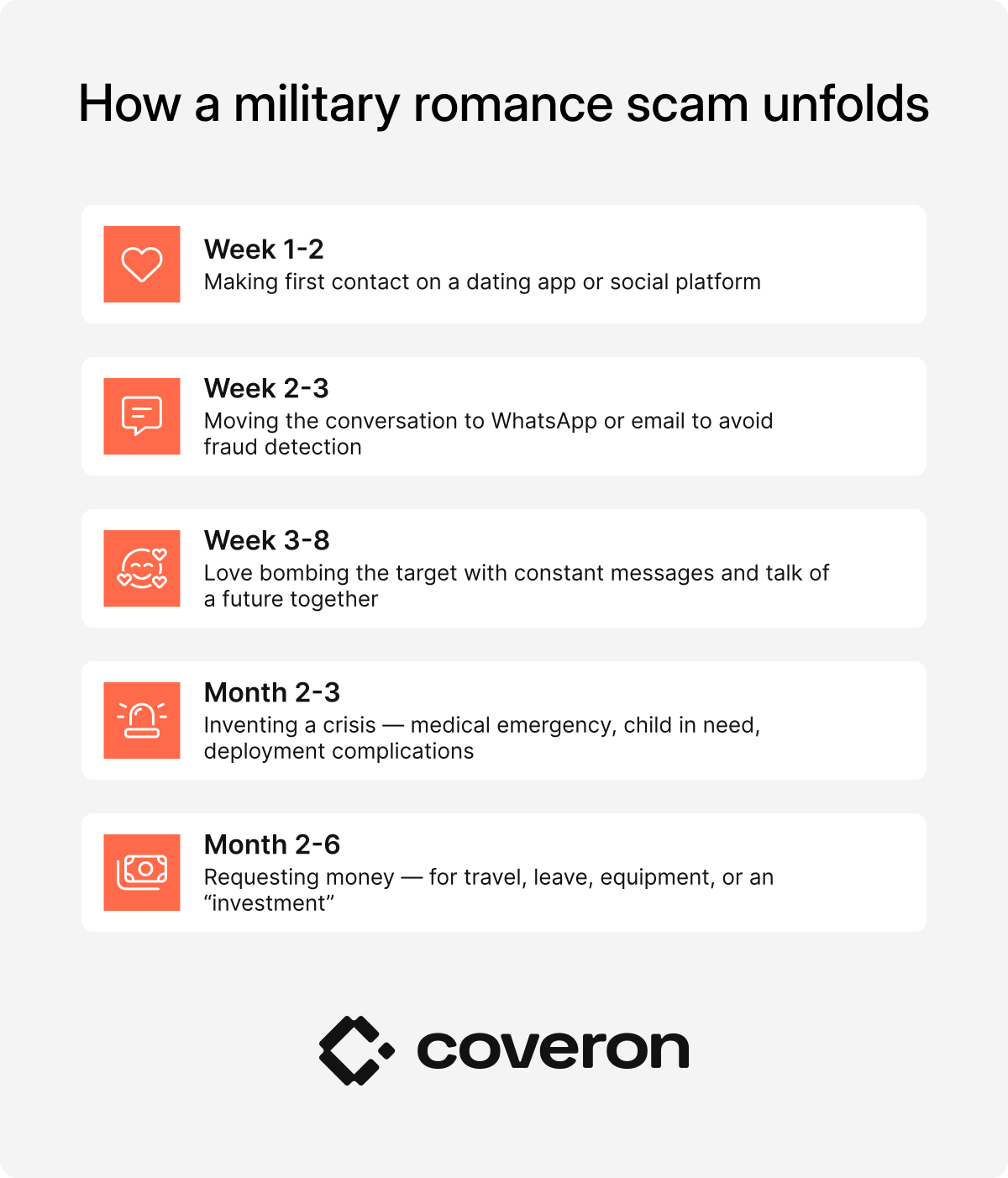
A military romance scam is a fully online scam — the two people never actually meet in person. Every step of the scam is designed to deepen emotional investment while keeping the scammer anonymous and unreachable.
Step 1: Building the fake profile
The first step in a military romance scam is creating a convincing military identity. Scammers steal photos of real soldiers — often taken from public social media accounts or military tribute pages — and build a profile around them.
These impersonation scams are carefully constructed. The scammer adopts a fabricated identity, such as a decorated officer deployed to a conflict zone, a widower raising a child alone, or a soldier counting down the days until they can come home.
The photos show a trustworthy-looking person in uniform, and the bio reinforces the persona with details about rank, unit, or deployment location. Some scammers use AI-generated images that have no real person behind them at all.
Step 2: Making first contact
With the profile ready, the scammer reaches out. They target people who appear open to connection — often those who post about military appreciation, belong to support groups for veterans, or show signs of loneliness or recent loss.
Initial contact often happens through direct messages on dating sites or social media platforms, then quickly moves to private messaging apps like WhatsApp or email to avoid the initial platform’s fraud detection systems. In fact, romance fraud is among the most common WhatsApp scams.
Step 3: Love bombing
Once contact is established, the scammer accelerates the relationship at a pace that can feel intoxicating. They message constantly, use affectionate language early, and express feelings that seem disproportionate to how long the scammer and the target have known each other.
Psychologists call this tactic “love bombing” — an overwhelming show of affection designed to bypass rational judgment and create emotional dependency fast. The scammer may talk about the future — coming home, building a life together — sometimes within the first few weeks.
Step 4: Inventing a crisis
Once the scammer secures emotional investment, they invent a problem. It’s always urgent and always just out of the scammer’s control — a medical emergency involving a child, an injury in the field, a commanding officer demanding a fee, or a bureaucratic obstacle preventing them from taking leave.
Step 5: The financial ask
With the crisis established, the request arrives. The scammer asks for money — via wire transfer, gift cards, cryptocurrency, or a peer-to-peer payment app. They may also pull you into an investment scam, urging you to put money into a time-sensitive opportunity that requires immediate funds. If you send money, a new crisis follows. The cycle continues until you stop engaging or the scammer disappears.
20 military romance scam tactics
Military romance scammers follow patterns — and once you know them, they become easier to spot. The following tactics cover the full range of what these fraudsters do, from the first message to the final ask. Each one is followed by an explanation of what the tactic looks like and how to recognize it.
1. They claim to be deployed overseas and can’t meet in person
Deployment is the cornerstone of the entire scam. It explains why they can’t meet you, why they can’t video call, and why they need money for expenses the military should cover. Scammers almost always claim to be stationed in a conflict zone — Syria, Afghanistan, Iraq, or in the location of an unnamed peacekeeping mission — to add credibility to their story and make their refusals to meet or video call seem legitimate.
HOW TO SPOT IT
Real deployments have end dates, and service members come home. If someone has been “deployed” for years with no clear timeline, pushes back on every attempt to arrange an in-person meeting, and uses deployment as a reason for every request, that’s a red flag. Standard U.S. military deployments typically last between 90 days and 15 months.
2. They avoid video calls or make excuses for why they can’t have one
Scammers know a live video call would expose them, so they manufacture reasons it can’t happen, including a poor internet connection, security restrictions, special forces protocols, or a broken device. Some may send brief, low-quality videos — pre-recorded or generated using deepfake technology — to create the impression you’ve “seen” them.
HOW TO SPOT IT
The military doesn’t prohibit service members from video calling family, friends, or romantic partners. Many bases have dedicated video chat facilities. If someone messages you daily but can’t manage a single live video call over weeks or months, treat that as a warning sign.
3. Their stories are vague or inconsistent
Scammers often operate from scripts, and those scripts have missing pieces. Details about their base, unit, commanding officer, or deployment history may change over time. They may avoid naming specific locations, claim their mission is classified, or give answers that contradict earlier conversations.
HOW TO SPOT IT
Ask specific questions — base name, military occupational specialty, rank, years of service — and pay attention to how they answer. Evasive, vague, or changing answers suggest the person doesn’t have the background knowledge a real service member would have.
4. Their English seems inconsistent with their claimed background
Many military dating scams are run by organized fraud groups operating from multiple countries. Despite claiming to be American-born and educated, the scammer’s writing may include unusual phrasing, grammatical patterns inconsistent with native English, or spelling errors that change from message to message.
HOW TO SPOT IT
Notice if the language quality changes dramatically between messages — polished in some, broken in others. Scammer teams often share accounts, and multiple people may be managing the same persona at different times.
5. They move the conversation off the dating platform very quickly
Dating platforms monitor for suspicious behavior and can remove fraudulent accounts. Scammers know that platforms do this, so they push to move the conversation to WhatsApp, Telegram, Signal, or personal email as quickly as possible — often within the first few exchanges.
HOW TO SPOT IT
A person with genuine intentions has no urgent reason to move the conversation off a dating platform in the first few days. If someone pushes hard to switch to private messaging before you’ve had a chance to get to know them, question it.
6. Their leave or homecoming keeps getting postponed
A classic manipulation tactic is promising to visit — and then finding a reason why it can’t happen. The leave was denied. A new crisis occurred. A fee was required to process the paperwork. Each postponement is accompanied by a new emotional plea and often a new financial request.
HOW TO SPOT IT
Military leave is managed by the U.S. military — not purchased by the service member or arranged through outside parties. No real soldier will ask you to pay for their leave or contact you to arrange travel on their behalf.
7. They claim to be widowed with a child
The widower-with-a-child narrative is one of the most common in military romance scams. It serves several purposes: it explains why the scammer is on a dating platform, it generates immediate sympathy, and it creates a recurring financial pressure point — the need to pay the child’s nanny, school fees, or medical treatments can be invoked at any time.
HOW TO SPOT IT
A widowed military officer raising a child while deployed is a real possibility, but it’s also a documented pattern in these scams. Be cautious if they describe themselves this way early in the relationship.
8. They discourage you from telling friends or family about the relationship
Isolation is a deliberate tactic. Scammers know that a trusted friend or family member is far more likely to spot the red flags than someone caught up in a new romantic connection. They may frame secrecy as a sign of special intimacy (“this is just between us”) or plant seeds of doubt about the people in your life.
HOW TO SPOT IT
A genuine partner who cares about you will want you to have support around you. If someone actively discourages you from sharing the relationship with people you trust, that’s a control tactic — not a romantic one.
9. Their social media profile was created recently
Many scammers build profiles from scratch specifically for the purpose of fraud. A profile created weeks or days before they contacted you, with few posts, no tagged content, and a small or nonexistent network, is a warning sign — especially when it’s paired with professional-looking photos and claims of a long military career.
HOW TO SPOT IT
Check the creation date of their social media accounts, look at the volume and variety of posts, and check whether anyone in their network interacts with their content in a way that looks organic.
10. Their photos look too polished or professional
Stock-image quality photos, studio-style headshots, or consistently perfect lighting across multiple photos are a red flag. Real people’s social media photos are a mix of casual and formal moments. When the images look like they belong in a recruitment brochure, they warrant a closer look.
HOW TO SPOT IT
Run a reverse image search using Google Images or a tool like TinEye. Upload or drag the photo and see what comes up. If the same image appears under multiple different names or profiles, you’re likely looking at a stolen photo.
11. Their photos appear elsewhere online under different names or unrelated profiles
Scammers reuse photos because sourcing convincing military images takes effort. The same soldier’s face may be used across dozens of fake profiles simultaneously, often with different names, ranks, and backstories.
HOW TO SPOT IT
If your reverse image search turns up the same photo under a different name, a stock photo site, or an unrelated profile, treat that match as confirmation that the profile is fake. You can also search the name they’ve given you alongside the word “scam” to check whether others have flagged the same persona.
12. The relationship moves unusually fast
Love bombing is central to how these military catfish scams work. The scammer may tell you they love you within days or weeks, talk about marriage early on, or describe the relationship as fate. The speed is intentional — it creates emotional attachment before you’ve had time to assess the situation objectively.
HOW TO SPOT IT
Pay attention to how quickly the emotional intensity escalates relative to how much you actually know about the person. Genuine connections develop over time. Anyone who declares deep romantic feelings before you’ve even had a video call is moving at a pace designed to cloud your judgment.
13. They express intense jealousy or possessiveness early on
In addition to love bombing, some scammers use jealousy and possessiveness as control tactics to deepen emotional dependency. They may express hurt or anger if you don’t respond quickly, question your loyalty, or frame their intensity as evidence of how deeply they feel.
HOW TO SPOT IT
Possessiveness and jealousy at the early stages of a relationship — before you’ve even met in person — are signs of manipulation. Combined with other red flags on this list, they indicate a deliberate effort to control the relationship dynamic.
14. They ask for personal information early on
A scammer’s goal is either money or personal data — and often both. They may ask for your home address under the guise of sending a gift, request your date of birth as part of getting to know you, or ask for financial details framed as a step toward building a shared future.
HOW TO SPOT IT
Never share your home address, Social Security number, date of birth, financial account details, or passport information with someone you haven’t met in person and verified. Personal information is as valuable to a scammer as cash — it can be used for identity theft long after the romantic contact ends.
15. They claim they can’t access their military pay or bank account
One of the most common financial setups in military romance scams is a scammer claiming they can’t access military pay or a bank account. They cite a technical issue, a banking restriction on deployed accounts, or an administrative error, and ask you to help bridge the gap temporarily.
HOW TO SPOT IT
Active-duty U.S. service members can access their bank accounts while deployed and receive their pay without interruption. The military doesn’t freeze accounts during deployment. Any story about a person being locked out of their finances and needing outside financial help is false.
16. They ask for money via gift cards, wire transfer, or crypto
The payment methods scammers request are deliberately chosen to be difficult or impossible to reverse. Gift cards, wire transfers, and cryptocurrency leave little trace, can cross borders instantly, and offer almost no recourse once the money is gone.
HOW TO SPOT IT
Any request for money via these channels from someone you haven’t met in person is a scam. It doesn’t matter how convincing the reason sounds. Active duty service members have access to military financial support channels and will never ask a romantic contact to send money through untraceable methods.
17. A manufactured crisis appears just before asking for money
The timing of a crisis in a military romance scam is rarely coincidental. It occurs after the emotional investment is established and just before the financial ask. The crisis is designed to override rational thinking with urgency and sympathy — a child’s surgery, a combat injury, a commanding officer demanding payment for equipment or travel documents.
HOW TO SPOT IT
Notice the pattern — emotional escalation, followed by a crisis, followed by a request for money. If a financial request appears immediately after a dramatic event, slow down and consider the sequence.
18. They ask you to send or receive money on their behalf (“money muling”)
Some military romance scammers don’t ask for money directly. Instead, they ask you to receive a payment to your account and forward it elsewhere — framed as helping them move funds out of a conflict zone or manage their finances while deployed. What they’re actually doing is using you to launder money from other fraud victims.
HOW TO SPOT IT
Receiving money from a third party and forwarding it to someone else — even someone you trust — makes you a money mule. This is a criminal act, regardless of whether you knew about the fraud. Never accept this request under any circumstances.
19. They claim to need money for a “satellite phone” or special communication device
This tactic is specific to military romance scams and is designed to sound plausible to anyone unfamiliar with how military communication works. The scammer claims that the only way to continue the relationship is through a special secure device that requires purchase fees or subscription costs — and asks you to cover it.
HOW TO SPOT IT
The U.S. military provides communication equipment and infrastructure for deployed service members. It doesn’t ask personnel to purchase their own satellite phones or pay subscription fees to contact family. If someone asks you to fund their ability to communicate with you, that request alone is a red flag.
20. Your gut tells you something is wrong
Scammers are skilled at manufacturing plausible explanations for every inconsistency. But the cumulative weight of small doubts — a story that changes, a feeling that the affection is shown too intensely and too soon, and an answer to a direct question that sounds scripted or doesn’t quite fit — adds up. That instinct is worth listening to.
HOW TO SPOT IT
If you find yourself explaining away red flags, making excuses for someone’s behavior, or feeling vaguely uneasy without being able to articulate why, pause and talk to someone you trust. Share the conversation with a friend or family member. A fresh perspective often catches what emotional involvement obscures.
PRO TIP
If a military romance scammer has accessed your personal information, an identity theft recovery service like one from Coveron can help you take control after a scam — from disputing fraudulent accounts to restoring your identity with expert guidance.
How to spot a military romance scammer
Recognizing the signs of a military romance scammer is the first line of defense. Vigilance and verification go hand in hand — you can take concrete steps to learn more about someone before you become emotionally invested, from examining their online profile to asking the right questions and using official resources to confirm whether they’re actually serving in the U.S. military.
How to spot a military romance scammer’s profile on dating apps and social platforms
Military romance scams on Instagram, Facebook, dating apps, and other social platforms share similar characteristics. The profiles are built to look convincing at first glance — a trustworthy-looking face in uniform, a brief bio about being deployed, or a story designed to generate sympathy. But a closer look usually reveals the cracks.
- Do a reverse image search. If the same image appears under a different name, on a stock photo site, or across multiple unrelated profiles, the photo is stolen.
- Search their name on Google. Look for any mention of the name alongside words like “scam,” “fake,” or “romance fraud.” Scammer groups reuse identities until they’re exposed, and previous targets often post warnings online.
- Check how long the profile has been active. A Facebook or Instagram account created recently with few posts, no tagged content, and a small follower count is a warning sign — especially when paired with claims of a long military career.
- Check for engagement. A profile with hundreds of followers but no genuine interaction is suspect.
- Look at the profile as a whole. Common signs of a military catfish include identifying as a widower, mentioning children being cared for by a nanny, and posting photos exclusively in military uniform with no casual or personal images.
PRO TIP
For Instagram scams in particular, watch for accounts that follow many people but have few followers themselves, post infrequently, and have no content showing a personal life outside their claimed military role.
Questions to ask a potential scammer
Asking direct questions about military life is one of the fastest ways to expose a fraudster. Real service members can answer these without hesitation. Scammers typically give vague, deflecting, or evasive responses.
Try asking:
- What base are you stationed at? A real service member will name a specific installation.
- What’s your MOS or rate? Depending on their branch, service members have a military occupational specialty (MOS) or a rating — both are specific job codes that every service member knows.
- Who is your commanding officer? A real service member can name this person and their rank without hesitation.
- What branch do you serve in, and what’s your specific unit?
- What’s your deployment timeline? Real deployments have a beginning and an end.
Don’t accept generic or emotional deflections as answers. If someone claims the information is classified every time you ask a factual question, that’s not military protocol — it’s evasion.
How to verify if someone is really in the military
One official resource allows you to check whether someone is actually serving in the U.S. military — the SCRA Military Verification Service, operated by the Department of Defense, at scra.dmdc.osd.mil. It lets you verify that someone is on active duty by creating a service record request.
If the person you’re speaking with is genuinely in the military, this resource will help confirm it. If that person objects to you verifying their service, the objection itself is a red flag.
What to do if you’ve fallen victim to a military romance scam
If you’ve fallen victim to a military romance scammer, it’s important to act quickly and calmly. It can be devastating to realize that someone you trusted was deceiving you, but that response is a result of deliberate manipulation — not a failure of judgment on your part. These scams are designed by professional fraudsters who study human psychology. The fact that the scam worked doesn’t reflect on your intelligence or your worth.
Here’s what to do:
- Stop all contact and stop sending money or personal information. End the conversation. Don’t send additional funds, even if the scammer pressures you or threatens consequences.
- Contact your bank or payment provider. If you sent money via bank transfer, a payment app, or a credit or debit card, contact your financial institution. Ask whether the transaction can be stopped, reversed, or disputed.
- If you used gift cards, contact the card issuer. Some companies can freeze unused balances if you act fast enough. Explain that you were defrauded and provide the card details.
- Document the details. Save all messages, photos, payment confirmations, and any other communication you had with the scammer. You’ll need this for official reports and for your bank.
- Place a fraud alert or credit freeze. If you shared personal information like your Social Security number, date of birth, or bank details, contact one of the three major credit bureaus — Equifax, Experian, or TransUnion — to place a fraud alert. Consider a credit freeze to prevent new accounts from being opened in your name.
PRO TIP
Coveron’s online fraud insurance can help you recover eligible financial losses from online scams, giving you a financial safety net when you need it most.
- Change your passwords. Update passwords on your email, banking apps, and any other accounts whose details you may have shared with the scammer.
- Seek support. Military romance scams are emotionally damaging. Talking to a counselor, a trusted friend, or a support group can help you process what happened and recover.
- Report the scam. Reporting helps authorities track scam patterns, warn others, and potentially recover funds or hold the scammer accountable.
Where to report military romance scams
To report a military romance scammer, use as many of the following channels as apply to your situation. The more information you provide — including screenshots, usernames, payment records, and the platform where the scam occurred — the more useful your report will be. The main channels for filing a report include:
- The Federal Trade Commission (FTC). Report at reportfraud.ftc.gov. The FTC gathers fraud reports to identify patterns and assist investigations.
- The FBI Internet Crime Complaint Center (IC3). File a complaint at ic3.gov. The IC3 handles cybercrime and online fraud cases, including romance scams.
- Local law enforcement. File a police report, especially if you sent a significant amount of money. Many banks and credit bureaus require a police report to process fraud disputes or claims.
- The platform where the scam happened. Report and block the scammer’s account on the dating app, Facebook, Instagram, or wherever you were contacted. Doing so helps the platform remove the profile and prevent the same fraudster from targeting others.
- Identitytheft.gov. If your personal information was compromised, visit identitytheft.gov to create a personalized recovery plan.
How to protect yourself online and avoid military romance scams
Some practical steps can reduce your risk of falling for a military romance scam and protect you more broadly when you’re meeting new people online.
- Do a reverse image search on any new contact’s profile photos. This step takes two minutes and can immediately reveal a stolen image.
- Move slowly. Take your time getting to know someone. Be cautious with anyone who pushes for fast commitment.
- Never send money to someone you haven’t met in person. No matter how compelling the reason sounds, any financial request from an online contact you’ve never physically met should be declined.
- Stay on the dating platform as long as possible. Dating apps have fraud detection systems. Switching to private messaging early removes those protections.
- Verify military claims through official channels. Use the SCRA Military Verification Service mentioned above before deepening a relationship with someone claiming to serve.
- Talk to people you trust about your online relationships. A friend or family member can offer a perspective that’s hard to maintain when emotions are involved.
- Protect your personal information. Don’t share your address, date of birth, financial details, or ID documents with someone you’ve only met online.
- Use identity and scam protection tools. If you’ve shared personal details with someone you met online, Coveron’s scam protection service monitors the dark web for signs your information has been exposed and provides coverage if you fall victim to online fraud. Pairing it with steps to prevent identity theft helps close the gaps a scammer could otherwise exploit.
Get notified and act immediately.
30-day money-back guarantee
FAQ
References
1 Federal Trade Commission (2026, July 28). FTC Consumer Sentinel Network. Tableau Public. https://public.tableau.com/app/profile/federal.trade.commission/viz/shared/4WS8HTYQ6 opens in a new tab