Can someone steal your identity with your license plate number?
A plate number on its own won’t get anyone far toward stealing your identity. Identity thieves need identifiers that let them pass as you to a bank, lender, or government office, such as your Social Security number, your date of birth, or your financial account number. A plate doesn’t link to any of that on its own, so it can’t be used by itself to open a credit line, file a fraudulent tax return, or take out a loan under your name.
The risk grows when a plate shows up alongside other exposed data. If a scammer has your driver’s license number, home address, or phone number from an old breach, the inclusion of a plate photograph can make an impersonation attempt or phishing message more convincing. A leaked driver’s license number has the ability to cause more damage than a plate number since it’s a government-issued ID tied directly to you rather than to a car, which is why a driver’s license number alone can be enough for someone to steal your identity in a way a plate number isn’t. That’s also the line between data that counts as personally identifiable information and data that doesn’t carry the same weight on its own, a distinction worth understanding if you want a fuller sense of what personal information is actually worth guarding closely.
What information can someone get from your license plate number?
A basic plate lookup tool, the kind available through some state DMV websites or commercial plate-check services, returns the vehicle’s make, model, year, registration state, and sometimes the VIN. Your name, address, and phone number stay private, since the Driver’s Privacy Protection Act locks those details inside DMV records a casual search can’t access.
Paid vehicle history reports pull from a different source — a car’s 17-character VIN, which draws on state motor vehicle agencies, insurers, auctions, and repair shops rather than the plate itself. They cover title brands like salvage or flood damage, reported accidents, odometer readings, and past ownership count, none of which identifies who owns the car today. Despite what some sites imply, a plate search won’t surface a criminal record either, since court and law enforcement databases aren’t linked to motor vehicle records by plate number.
A basic lookup and a restricted DMV record don’t return the same information either. That difference is worth knowing before you assume a plate number exposes more than it does.
| Information | Basic public lookup | Restricted DMV record |
|---|---|---|
Car’s make, model, year | ✅ | ✅ |
Registration state | ✅ | ✅ |
VIN | Partially, depending on the source | ✅ |
Title brand, accidents, odometer | Via paid VIN report | Varies by state |
Owner’s name | ❌ | Permissible purpose only |
Home address | ❌ | Permissible purpose only |
Phone number | ❌ | Permissible purpose only |
Even the full restricted record, the version only police, insurers, or other authorized parties can access, is narrower than the information that gets leaked through other channels. A phone number or an email address typically exposes far more data since both connect directly to your accounts and logins, while a plate number doesn’t. It’s worth freshening up your knowledge on what someone can do with your phone number and what someone can do with your email address.
Can someone find your address from your license plate number?
No average person can legally pull your name or home address from DMV records with just your plate number, since the Driver’s Privacy Protection Act limits that lookup to people with a permissible purpose.
A couple of workarounds exist, neither of which relies on a public plate lookup. Someone with a permissible purpose, like a private investigator or an insurer handling a claim, can request owner information properly. People-search sites and data brokers build profiles from public records and old breaches, not DMV data, so they can’t connect a plate to an address either, but if someone already has your name, those sites can make finding your home address fairly easy. Read up on what someone can do with your address once they have it in our article.
Physical observation remains the most effective way to connect a plate to an address — someone who recognizes your car and follows it, or notices it parked in the same spot regularly, can learn where you live or work without visiting a single website.
Someone searching for your name from your plate will likely be frustrated since this information is also protected by the DPPA.
How does the Driver’s Privacy Protection Act safeguard your information?
The Driver’s Privacy Protection Act (DPPA) restricts who can access personal information held by state Departments of Motor Vehicles (DMVs). Congress passed this law in 1994 following the murder of actress Rebecca Schaeffer. In 1989, a stalker obtained her home address from a private investigator who had acquired it from California’s DMV.¹ The stalker then used the address to find and kill her. The case exposed serious gaps in driver privacy protections and helped bring the law into existence, now codified in Title 18 of the U.S. Code.²
The DPPA protects personal information found in motor vehicle records, including your name, address, phone number, Social Security number, driver’s license number, photograph, and medical or disability information. However, it generally doesn’t cover vehicle-related details, such as license plate numbers, vehicle makes, or registration states. These details aren’t automatically confidential under the DPPA, although other laws may restrict access to them.
Violating the DPPA can have legal and financial consequences. Anyone who knowingly obtains, shares, or uses protected information for an unauthorized purpose may face a civil lawsuit and criminal fines.³ Courts may award liquidated damages of no less than $2,500 per violation, although eligibility depends on the circumstances.⁴ State DMVs that repeatedly disclose protected information unlawfully may also face federal penalties of up to $5,000 per day.⁵
Who can legally look up your license plate?
A handful of groups can request the personal information tied to your plate when they have one of the DPPA’s permitted reasons to do so:
- Law enforcement and other government agencies doing their jobs.
- Courts and attorneys working on civil, criminal, or administrative cases.
- Insurance companies investigating claims, underwriting policies, or chasing down fraud.
- Towing and impound companies that need to notify an owner.
- Licensed private investigators working within an allowed purpose.
- Businesses confirming details you already gave them directly, like during a car sale.
A police officer running your plate during a traffic stop or routine patrol doesn’t need to justify it under any of those commercial categories, since law enforcement work is its own permissible purpose under the statute.
What are legitimate reasons to look up a license plate?
Most plate lookups are about as exciting as checking the weather. Someone buying a used car runs the VIN first to see if it’s been in an accident or carries a salvage title. A witness to a hit-and-run, a reckless driver, or an abandoned car passes the plate along to police. A driver in a fender-bender hands their insurer the other car’s plate number to help process the claim. None of it involves anything more dramatic than routine paperwork.
5 real ways someone could misuse your license plate number
Although the DPPA restricts access to personal information in DMV records, it doesn’t eliminate every risk associated with your license plate number. Scammers, stalkers, and other bad actors may use it alongside publicly available information or details they already know about you. Here are five ways someone could misuse your license plate number.
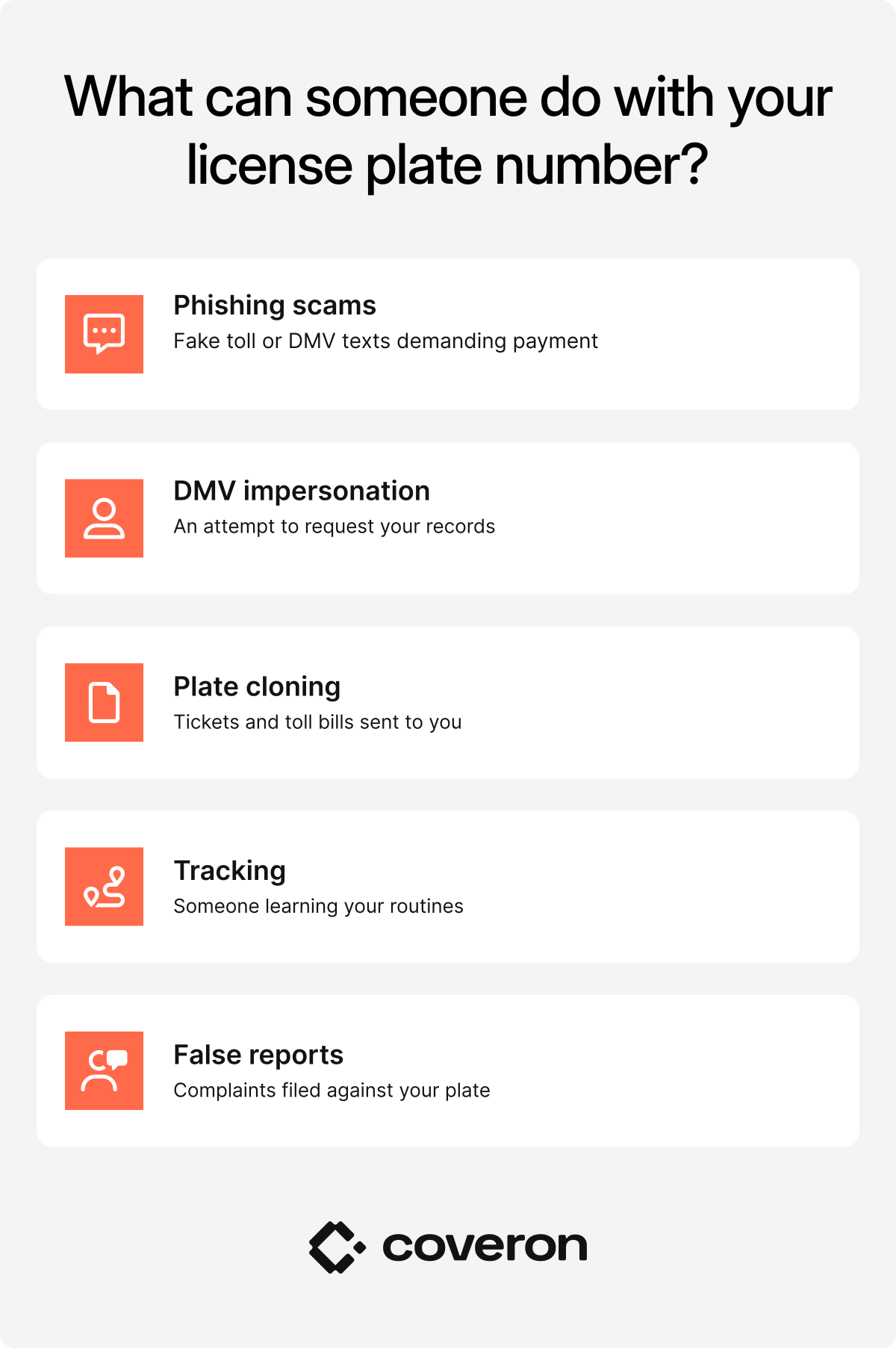
1. Phishing scams that use your license plate number or other vehicle details
Toll and DMV phishing texts follow a predictable pattern: a message claims you owe an unpaid toll, parking fine, or DMV fee, with a link to pay immediately. Between early March and April 2024, the FBI’s Internet Crime Complaint Center received more than 2,000 complaints about this kind of toll-related smishing text, spreading across at least three states.⁶ The bureau’s 2024 annual report counted 59,271 complaints under the toll-scam category for the year.⁷ The FTC has separately warned that these messages are almost always scams since legitimate tolling agencies don’t threaten immediate suspension by text.⁸
Most people don’t realize scammers send these texts out in bulk to random numbers and don’t need your real plate number to get the reaction that they desire. An accurate detail just makes the message feel more legitimate.
Watch for the usual red flags, such as an urgent deadline, a threat about license suspension, an unfamiliar link, or a request for your card number or Social Security number. Report suspicious messages to the FBI’s IC3 at ic3.gov and delete them. If you’ve already shared your email address with a scammer, our guide on what to do if a scammer has your email address covers the next steps.
Coveron’s scam protection can help you identify suspicious activity before it causes harm. And if a scam costs you money, our online fraud insurance offers up to $100K in coverage for eligible incidents, with reimbursement subject to your plan’s terms and conditions.
PRO TIP
Don’t trust a toll or fine notice just because it has your correct plate number. Instead of clicking the link, go to your toll agency’s or DMV’s official website directly or call a verified number to check if you actually owe anything.
2. DMV impersonation using your plate and other stolen details
Someone trying to request your DMV records, a replacement registration, or duplicate plates can’t do so with just your plate number. DMVs require identity verification, such as a driver’s license number or date of birth, before releasing records, so this kind of fraud depends on a scammer already having stolen identity details, usually from a data breach rather than spotted off your bumper.
Other stolen documents contribute to the same risk. Knowing what someone can do with your passport number, what someone can do with a picture of your ID, or what someone can do with your birth certificate helps you recognize how different pieces combine toward identity fraud.
Coveron’s dark web monitoring scans known leak sources and alerts you if your Social Security number, email address, phone number, or credit or debit card number turns up exposed, giving you a head start before a fraudster collects enough for DMV impersonation.
3. License plate cloning
Plate cloning is when someone copies your license plate number and puts it on another vehicle, often one with a similar make, model, and color. They can then use the cloned plate to avoid paying tolls, parking fines, or traffic tickets, leaving you to deal with the consequences.
You might start receiving toll bills, speeding tickets, or collection notices for places you’ve never visited. In some cases, police may even contact you while investigating a crime involving the cloned plate, although this situation is less common.
PRO TIP
Don’t ignore toll bills or traffic tickets, even if the amounts are small. A charge from a road or city you’ve never visited could be an early sign that someone has cloned your license plate.
4. Movement tracking through your plate
A visible plate can be used to track your movements in two different ways: by a person who recognizes your car, or by camera systems that log it automatically.
Anyone who knows your car and your plate can spot it in a parking lot, outside your office, or near your house, which becomes a real safety concern in stalking or harassment situations. If you think someone is tracking you this way, call local police rather than confronting the situation yourself.
Automatic license plate readers (ALPRs) track plates on a larger scale. Police departments, parking operators, and some private companies run camera networks that log the time, place, and plate number of every car that drives past, which builds up a travel history for any given plate over time. Retention rules vary by state. New Hampshire wipes non-hit data within minutes, Georgia can hold it for up to 30 months, and roughly 20 states don’t cap retention at all.⁹ Access to this data generally stays with the agencies and companies running the cameras rather than being open to the public. If you think someone is using your plate to track you, call local police rather than handling it yourself.
5. False reports and retaliation after road rage
Someone you’ve had a confrontation with on the road can report your plate to police claiming reckless driving or try to track you down afterward using details they noted at the scene. A report by itself rarely turns into an actual ticket without evidence since officers need more than someone’s word to issue one. Dashcam footage can support your perspective if a dispute like this ever escalates into a formal complaint.
Should you be concerned if someone has taken a picture of your license plate?
Someone taking a picture of your license plate might seem suspicious, but it’s usually nothing to worry about. License plates are publicly visible information, and photographing one after a fender-bender, a parking-lot scrape, or any routine traffic dispute is a normal way to document what happened.
Pay closer attention if the photo follows a hostile confrontation rather than a routine incident like a fender-bender, or if a toll or DMV scam text referencing your vehicle arrives shortly after. Someone with no connection to your home, workplace, or daily route showing up near your car repeatedly, with no reasonable explanation, is a different matter worth taking seriously. If that happens, note the time, place, and a description of the person, and keep those details in case you need to report harassment to police.
Can you hide your license plate number?
You can’t legally hide or cover your license plate while driving in the US. States require license plates to remain visible, readable, and free from obstructions. For example, Pennsylvania prohibits plates that are too dirty to read or covered in a way that interferes with traffic cameras or toll systems. The state also explicitly bans tinted plate covers. In Pennsylvania, fines for plate obstruction start at around $25, sometimes with added court costs.¹⁰ But fines vary state by state.
Avoid products marketed as ways to hide your plate from traffic cameras, such as reflective sprays, tinted covers, or special films. These products can violate state laws and result in fines. Since specific requirements and penalties vary by state, check your local DMV’s rules before using any license plate accessories.
How can you reduce the risks tied to your license plate number?
You can’t keep your license plate number completely private, but a few simple precautions can help reduce the risk of scams, plate theft, and misuse:
- Blur your plate in photos you share online. Before posting pictures of your car on social media or marketplace listings, crop out or blur the license plate number.
- Check toll statements and traffic tickets. Review every toll bill, parking ticket, or camera citation you receive, even for small amounts. Unexpected charges from places you’ve never visited could indicate plate cloning.
- Use official websites to pay fines. Don’t follow payment links in unexpected texts. Instead, visit the toll agency’s or DMV’s official website directly to verify and pay any outstanding charges.
- Protect your physical plates. Use tamper-resistant screws to make it harder for thieves to remove your license plates.
- Report stolen or missing plates immediately. Contact the police and your DMV to report the theft and ask about replacing your plates.
- Limit your exposure on people-search websites. Opt out of data broker listings where possible to make it harder for strangers to find your personal information, including your home address.
- Keep vehicle documents secure. Don’t leave your title or other sensitive paperwork in plain sight. Store your title securely at home and follow your state’s requirements for keeping registration documents in your vehicle.
Keep your registration and title out of plain sight in the car, for instance in a glovebox or console rather than left visible on a seat or dashboard. A stolen ID can put you at risk of identity theft by giving criminals access to details they could use to impersonate you, so it’s worth carrying your driver’s license on you instead of leaving it in the vehicle between drives.
What should you do if someone is using your license plate number?
If you suspect someone has stolen or cloned your license plate number, a quick response saves you time and money since every day you wait is another day fines and collection notices can pile up:
- Gather evidence, such as copies of tickets or toll notices, photos of your actual plate and car, and proof of your whereabouts, such as GPS history, receipts, or dashcam footage.
- File a police report for a stolen or cloned plate and keep the report number.
- Contact your state DMV to report the issue and ask about replacement plates with a new number.
- Dispute each citation or toll charge directly with the issuing agency, attaching your police report as supporting evidence.
- If your personal information was also used, for example in a DMV record request or an account opened in your name, report it at IdentityTheft.gov and consider placing a fraud alert or credit freeze.
- If you have lost money to a toll or DMV text scam, contact your bank or card issuer immediately, then report the scam to the FBI’s IC3 at ic3.gov and the FTC at reportfraud.ftc.gov.
If plate misuse turns into identity theft, Coveron’s identity theft recovery service gives you a dedicated case manager and up to $2M in coverage for eligible recovery expenses. A dedicated case manager guides you through the recovery process, and eligible recovery expenses may be covered under your plan’s terms and conditions. However, you’ll still need to work directly with the police, DMV, and relevant agencies to resolve plate-related violations and fraudulent charges.
References
- Electronic Privacy Information Center. (n.d.). The Drivers Privacy Protection Act (DPPA) and the privacy of your state motor vehicle record. EPIC. https://epic.org/dppa/ opens in a new tab
- Cornell Law School Legal Information Institute. (n.d.). 18 U.S. Code § 2721 – Prohibition on release and use of certain personal information from State motor vehicle records. https://www.law.cornell.edu/uscode/text/18/2721 opens in a new tab
- Cornell Law School Legal Information Institute. (n.d.). 18 U.S. Code § 2724 – Civil action. https://www.law.cornell.edu/uscode/text/18/2724 opens in a new tab
- Venable LLP. (February 4, 2026). What’s driving the rise in Driver’s Privacy Protection Act litigation? https://www.venable.com/insights/publications/2026/02/whats-driving-the-rise-in-drivers-privacy opens in a new tab
- Poyner Spruill LLP. (March 11, 2019). The Drivers Privacy Protection Act. https://www.poynerspruill.com/thought-leadership/the-drivers-privacy-protection-act/ opens in a new tab
- Federal Bureau of Investigation, Internet Crime Complaint Center. (April 12, 2024). Smishing scam regarding debt for road toll services (PSA240412). https://www.ic3.gov/PSA/2024/PSA240412 opens in a new tab
- Federal Bureau of Investigation, Internet Crime Complaint Center. (2025). 2024 Internet Crime Report. https://www.ic3.gov/AnnualReport/Reports/2024_ic3report.pdf opens in a new tab
- Federal Trade Commission. (January 17, 2025). Got a text about unpaid tolls? It’s probably a scam. Consumer Advice. https://consumer.ftc.gov/consumer-alerts/2025/01/got-text-about-unpaid-tolls-its-probably-scam opens in a new tab
- Congressional Research Service. (2026). Automated license plate readers: Background and legal issues (IF13068). Congress.gov. https://www.congress.gov/crs-product/IF13068 opens in a new tab
- Pennsylvania General Assembly. (n.d.). 75 Pa.C.S. § 1332 – Display of registration plate. https://www.legis.state.pa.us/WU01/LI/LI/CT/HTM/75/00.013.032.000..HTM opens in a new tab
Coveron monitors for personal data exposure and alerts you when it finds a match.
30-day money-back guarantee