Disclaimer
If you or a family member is facing sextortion, do not comply with extortionist demands — instead, you should report the crime to your local police department and seek support. For US citizens, you can report extortion to the Federal Bureau of Investigation (1-800-CALL-FBI) and IC3.gov. For victim support, consider using the Cyber Civil Rights Initiative Helpline (1-844-878-2274, [email protected]) or, if a minor is involved, the National Center for Missing and Exploited Children (1-800-THE-LOST, [email protected]). If you live outside the US, consider contacting local police and your national cybercrime unit.
What is sextortion?
Sextortion is a type of blackmail during which somebody threatens to expose sexually explicit content (typically private pictures and videos) of a person unless that person pays money, sends more explicit content, or complies with other demands. Today, sextortion is one of the most reported online scams and one of the most damaging forms of online fraud overall, punishable by law as a criminal offense.
Sextortion perpetrators use online apps such as Snapchat, WhatsApp, Discord, or Instagram to groom people into sharing nude or sexual images. Once targets send their private pictures or videos, “sextortionists” will record the content and use it to threaten their targets with public exposure unless they meet the blackmailer’s demands. Depending on the approach and the target, it may take perpetrators from just under an hour to a few days to successfully pull off the crime.
The term “sextortion” combines the words “sex” and “extortion.” It describes a practice documented as far back as the18th century, when “criminals realised that the laws against sodomy could enable them to entrap men, and extort their money” [1].
How does sextortion work?
Sextortion works in a specific pattern that includes initial contact, coaxing the target into sharing explicit content, and threatening to share it publicly unless the target sends money, grants favors, or otherwise submits to the perpetrator's will. Sometimes sextortionists may use fake or AI-generated images of the target to skip the coaxing stage and go straight to the extortion phase.
- Initial contact. Criminals contact their target via social media, dating apps, or messaging platforms posing as attractive strangers. They may pretend to be looking for a romantic interest or strike up a friendly conversation to build trust.
- Coaxing stage. Sextortionists lead the conversation toward explicit topics, tricking the victim into sending intimate photos or performing on camera (often by playing a pre-recorded video of someone else to fake reciprocity).
- Extortion. Once they have compromising material, perpetrators immediately switch into extortionist mode. Scammers threaten to send the images to the victim's family, friends, or employer, unless the victim does what they’re told. Criminals may demand money (usually from $100 to $2,000 in crypto or gift cards, since it's hard to trace) or more explicit content. Submitting to these orders rarely ends the extortion — demands usually continue growing.
What tactics do sextortionists use?
Sextortionists typically find their targets through popular social media platforms (such as Snapchat, Discord, Instagram, or WhatsApp). On these platforms, blackmailers engage in chatting and “innocent” flirting with unsuspecting, impressionable users to coerce them into sharing explicit photos and videos.
Sextortion can have many different faces and appear in various scenarios, with the most common including:
- Fake personas. Online scammers can pose as a peer of the same age or an attractive person to build their target’s trust, often by using stolen or edited photos.
- Catfishing. Sextortionists can pretend to have a romantic interest in the target, encouraging them to send intimate photos or engage in explicit webcam activity. They may also send an often stolen or manipulated nude photo first to entice them to reciprocate.
- Secret recording. Sometimes, instead of chatting, the perpetrators coerce the target into a video call where they can manipulate the victim into sexual activity and secretly record it.
- Hacking. Tech-savvy scammers may hack into a victim's devices to steal private images or even remotely record them through the hacked webcam without the victim’s knowledge.
- Tricking victims with links. Scammers can send links to phishing sites designed to steal login information or download malware that gives them access to a victim's files and personal data. These links can look like copies of legitimate website login pages yet often contain spelling errors, low-quality images, or suspicious URLs.
- Using artificial intelligence (AI) to create fake images. Some sextortionists may use AI-generated or digitally manipulated nude or sexual images to threaten victims. Since AI is capable of generating realistic high-quality images, such tactics might affect even those who have never taken or shared nude or sexual images.
Who are the victims of sextortion?
According to the Federal Bureau of Investigation (FBI), sextortion cases typically target minors, particularly boys aged 14–17 [2]. However, sextortion targets can range from children under 13 to adults. The data from the 2025 FBI’s Internet Crime Complaint Center (IC3) report also suggests sextortion as a popular cybercrime tactic, with IC3 reportedly receiving more than 75,000 sextortion complaints in 2025.[3]
Data also suggests that sextortionists may select targets based on their sexual orientation. According to the Thorn nonprofit organization, LGBTQ+ teens are twice as likely to experience sextortion compared to their non-LGBTQ+ counterparts [4]. Another troubling statistic is that 1 in 3 sextortion targets know their extortionists in real life as romantic partners, school peers, or even family acquaintances [5].
What are the most common platforms used for sextortion?
Sextortion can occur on any messaging platform. However, according to the National Society for the Prevention of Cruelty to Children (NSPCC), the top five apps include Snapchat, TikTok, Instagram, Discord, and WhatsApp [6]. In some cases, malicious actors may lurk in online games such as Roblox, which are popular among kids and teenage boys.
Blackmailers may also target dating platforms, such as Grindr or Tinder, looking for users who will engage in flirtatious and intimate conversations. The nature of these apps lets scammers commit romance fraud, sextortion, or engage in platform-specific schemes such as Hinge scams.
It’s important to understand that no messaging platform is completely safe from cyber extortion. Perpetrators will use any available app, whether it’s Snapchat, Reddit, Omegle, Discord, or any other platform that allows users to communicate via chat or video calls.
Sextortion cases
The number of sextortion cases has drastically increased during recent years. In 2024 alone, the National Center for Missing and Exploited Children (NCMEC) received nearly 100 reports of financial sextortion per day [7]. Below you’ll find some of the most notable sextortion stories in recent years.
CONTENT WARNING: The text below may contain information about sensitive topics such as sextortion, child abuse, and self-harm, which may be disturbing to readers.
- The Rotterdam case (2026). In 2026, a 20-year-old man in the Netherlands was accused of extortion and assault for pressuring and manipulating a 16-year-old girl he met on the Roblox platform into violently harming herself. He also allegedly forced her to record videos of the abuse. Prosecutors also claim the man threatened to publish nude photographs of the girl, forcing the 16-year-old to film herself performing sexual acts, carve the perpetrator’s online alias, “Master Zoro,” on her skin, and write texts such as “Zoro owns me” on her body [8].
- The Evan Boettler case (2024). In 2024, a 16-year-old from the US was contacted by a scammer pretending to be a girl. An unknown individual, posing as “Jenny,” convinced Boettler to share explicit images and then threatened to expose the pictures unless he paid the scammer. Just 90 minutes after the first message, Boettler took his own life. While the perpetrators have not been found, the investigation of this story led BBC journalists to Nigeria, where they discovered a meticulously organized sextortion operation, likely related to Boettler’s case. As tragic as this story is, it helped shine a light on sextortionist networks in Africa, showcasing how dozens of scammers work in groups to blackmail teenage boys as their day job [9].
- The Gavin Guffey case (2022). Gavin Guffey tragically fell victim to sextortion in July 2022. Scammers contacted the 17-year-old while posing as a woman, and sent him explicit images, encouraging him to do the same. Once Guffey sent the pictures, the criminals threatened to release them to the public unless the victim paid the scammers, which led to Guffey taking his own life. Following his son’s death, Representative Brandon Guffey, spearheaded legislation, later named “Gavin’s Law,” that declared sextortion a felony offense in the state of South Carolina [10]. In early 2025, the US Justice Department extradited a Nigerian national suspected of participating in this case to the United States, where he is awaiting prosecution [11].
What are the warning signs of sextortion?
The warning signs of sextortion include strangers and new contacts that rush into sexual and intimate topics very quickly, pressure you to send explicit content, or send it first to entice reciprocation (“I’ve shown you mine, now show me yours”). Other warning signs include:
-
Unsolicited friend or follow requests. Unexpected friends and follow requests from profiles with no mutual friends or followers are one of the ways blackmailers make first contact. Review these profiles carefully before engaging in conversation and avoid accepting invitations from suspicious profiles.
-
A rapid push to switch platforms. Sextortionists often ask their targets to move the conversation to a secondary platform (for example, from Instagram to Snapchat). If your contact seems adamant about switching platforms as quickly as possible, it’s a good indication that something’s not right.
-
Inconsistencies in communication. Sloppy blackmailers may reveal red flags such as resending the same videos, repeating questions they’ve already asked, or getting your name wrong.
-
Unsolicited explicit content. Sextortion scammers are often the first to send explicit images and videos as an encouragement for the victim to do the same. If you receive such messages, don’t give in to the requests.
-
Asking for pictures with your face. Sextortionists often ask their victims to take pictures (or record videos) from an angle that would make the victim easy to recognize. If you get asked to send content that would expose your face or other recognizable features (for example, tattoos), refuse and cut communication immediately.
-
Insistent urges to go on “live” calls. Another tactic blackmailers may use is urging their victims into interacting via live webcam calls. Avoid people who persistently invite you to live calls, especially if they’re asking for explicit content.
-
Emotional manipulation. In some cases, blackmailers may use tactics such as threatening to hurt themselves to get the victim to cooperate with their demands. Do not give in.
-
Inquiries about your personal information. Some sextortion scammers may engage in prolonged chatting to build trust and find the victim’s weak points. If you notice the person asking too many personal questions (particularly about your family and friends), keep your guard up.
-
Offers of virtual currency or online game credits. Sextortion scammers may lurk in video game (such as Roblox) chatrooms. In such cases, they can offer targets in-game currency as a means to grab attention or convince them to send explicit content.
Warning signs of sextortion for parents and caregivers
The biggest warning sign of child sextortion (or any other cyberbullying threat) for parents and caregivers is a sudden change in the child’s behavior (usually, an unexplained distancing and closing off from loved ones). In addition, your child may express warning signs such as:
-
Sudden anxiety around devices. Because of blackmailer threats, sextortion victims might get anxious seeing their family and friends using social media or other apps. If your child suddenly starts checking your phone or getting distressed when you scroll through social media, it might be a sign they’re being threatened.
-
Secrecy about online activity. Teenage boys and girls can be secretive about their private life online. However, if you notice a marked change in their online behavior (for example, deleted profile pictures or vague chat replies) it might be worth checking in with your child in person.
-
Unexplained requests for money or gift cards. Frequent money or gift card requests (especially for continuously increasing sums) are a dead giveaway that something’s up.
-
Social withdrawal. Sextortion scammers often pressure their targets into staying silent, which can leave them isolated from friends and family. If you notice a sudden change in your child’s social behavior, take action.
Are sextortion emails ever real?
Sextortion emails typically aren’t real, but they can pose a real threat if you give in to the sender's demands. These emails are typically mass-sent, claiming the sender has hacked your webcam and recorded you, which, while possible, is rarely the case.
If you receive a sextortion email, it’s important to maintain a level head and follow these steps:
- Don’t engage. Don't reply, don't pay, and don't click anything in the message.
- Change your password to maintain control over your email account.
- Turn on two-factor authentication (2FA) to add an extra layer of protection to your account.
- Report the email to the FTC (reportfraud.ftc.gov) if you're in the US, or to your national fraud reporting body.
If the sender does produce a real image or video of you and is using it to extort you, treat it as sextortion and follow the steps below.
How to deal with sextortion
If you get a sextortion email or message, do not respond to threats or demands. However, don’t ignore the situation either. Depending on your circumstances, here’s what to do when dealing with sextortion scammers.
What to do if you haven’t shared explicit content
If you suspect a sextortion attempt but haven’t yet shared explicit content with the perpetrators, you should immediately:
- Cut contact with the scammer. It’s best to not engage with scammers, so upon noticing suspicious activity, stop communicating with potential scammers either by blocking them or removing them from your contact list.
- Report the account. If you have a suspicion you might be dealing with a sextortionist, report the account to the platform you’re communicating on. Most social media and messaging apps have dedicated abuse reporting channels and continue to introduce tools to combat sextortion.
You can also report scammers to law enforcement. However, it’s best to do so once you have actual proof of suspicious activity (for example, screenshots of threats).
What to do if you’ve shared explicit content
If you have shared explicit content and are now receiving threats from blackmailers, follow these steps:
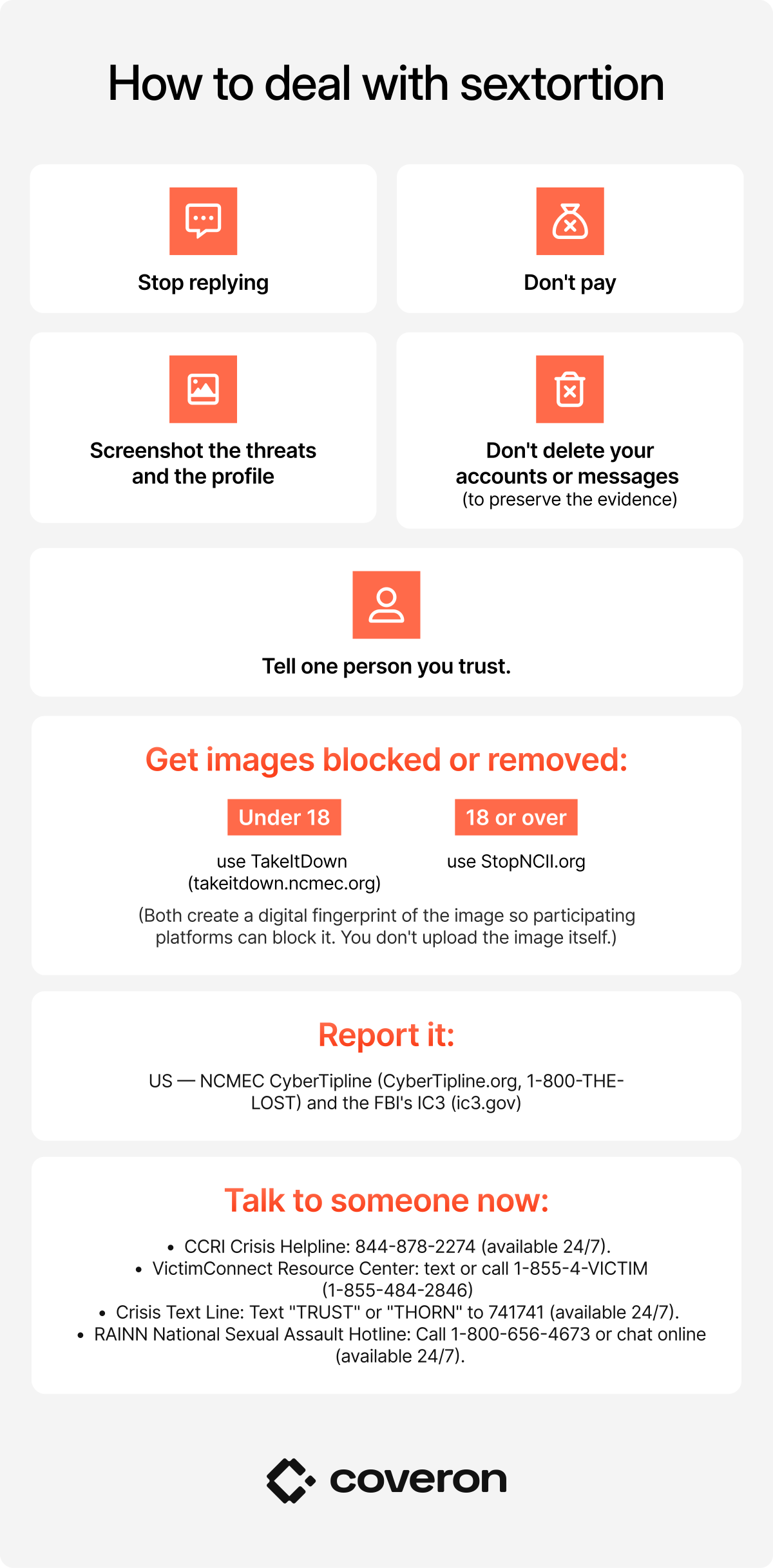
- Don’t pay or negotiate. Even if you’re being threatened, stop responding to the extortionist. These scams often rely on pressure and fear to extract quick payments, and scammers usually return even if you comply with their demands.
- Preserve evidence. Screenshot the message threats, save emails and chat threads, and keep original email headers and any usernames or profile links of the perpetrator. Do not delete messages or scammer account handles, since those are crucial pieces of evidence. To preserve email handles, download the raw message files or simply screenshot the sender’s email.
- Reach out for help. Scammers often rely on their victims to stay silent. Regardless, it’s best to ask for help, either from relatives or other trusted adults (for example, a school teacher).
- Contact content takedown services. Victims over 18 should contact services such as StopNCII (Stop Non Consensual Intimate Image Abuse). Initiatives like StopNCII help create a secure hash (a unique digital fingerprint that helps detect and block uploads) of your intimate images or videos so participating platforms can help remove explicit content. Meanwhile, minors can contact NCMEC (the National Center for Missing and Exploited Children) for help.
- Contact law enforcement. Contact your local FBI field office, either by phone (1-800-CALL-FBI) or online (fbi.gov) and file a complaint with the FBI’s Internet Crime Complaint Center (ic3.gov). Mention all information about the scammer (email addresses, usernames, phone numbers, if any), all payment details they provided (account numbers, platforms, crypto wallet addresses), message screenshots, and other factual information about the incident (the time you were contacted, whether you’ve sent money to the scammer, and, if known, how they got your contact information).
- Report the scammer to the FTC. If you experienced extortion via email or have become involved in other impersonation/scam tactics, consider reporting it to the FTC.
- Seek legal guidance. A legal expert can help you plan your next steps during the investigation and any legal proceedings that follow.
What to do if you have already paid the sextortionist
If you've already paid a sextortionist, stop sending them money (they’re likely to ask more) and act quickly to try to recover your losses. Depending on which payment method you used, the first steps might include:
- Contacting your bank immediately to report fraud and requesting a chargeback or wire recall for bank transfers.
- Reaching out to the money transfer service (such as Western Union or MoneyGram) to report the transaction and ask for a reversal.
- Contacting the payment app (PayPal, Venmo, Cash App) to report the transaction and ask for a reversal.
- Reaching out to the gift card issuer with your card numbers and receipts to freeze remaining funds.
If you used cryptocurrency to pay the sextortionist, the transaction is unfortunately nearly impossible to reverse. However, you should still report the wallet address to the platform and law enforcement.
Most importantly, stop paying sextortionists — research shows that 55% of victims who pay the perpetrators face continued threats afterward [12]. Instead, cease all contact, preserve all evidence, and report the crime to the police and the FBI (via IC3.gov), since paying only confirms you as a profitable target.
How to recover from sextortion
Dealing with the aftermath of any kind of extortion can be a long and exhausting process. To recover from sextortion, consider taking these steps:
- Do not blame yourself. It’s typical for scam, extortion, and fraud victims to blame themselves for falling into cybercriminals’ trap. However, you shouldn’t blame yourself for something that can happen even to the most vigilant people. Thousands of individuals suffer from sextortion every day, and there’s no way to be completely secure or impervious to cyberattacks, scams (especially social media scams), or fraud. Instead of blaming yourself, focus on recovery (both mentally and financially), try to improve your personal cybersecurity, and invest in tools that can minimize the risk of future exposure.
- Contact content removal services. If you’ve shared explicit content with extortionists, your shared images and videos might already be floating around the internet. Consider contacting external content removal services (such as those offered by StopNCII or NCMEC) that can help you remove exposed content.
- Seek professional help and support. Sextortion is a crime that can cause huge emotional and psychological trauma. If you or someone you know has suffered from this cybercrime, consider (or gently suggest) talking to a mental health professional.
- Take a break from social media. Sometimes taking a break from social media and messaging apps can help sextortion victims recover faster. Putting distance between yourself and communication platforms reduces the number of emotional triggers, minimizes the chances of scammers reappearing in your DMs (direct messages), and can help boost your overall mental health.
How to prevent sextortion
Preventing sextortion involves practicing vigilant behavior online, including avoiding exposing your personal information on social media sites and treating unsolicited messages carefully. Here are some more sextortion prevention tips:
- Be cautious with strangers online. Ignore or block messages from unknown people, especially those asking for explicit content or your personally identifiable information (PII). Remember — anyone online can fake photos or personas, even if their pictures seem realistic enough. Watch for inconsistencies and run a reverse image search on their photos. Remember that even realistic-looking pictures can be generated using AI.
- Don’t share intimate images. Even if the person seems trustworthy, think twice before sharing intimate or explicit content.
- Limit what you share. Avoid posting or sending personal photos and videos until you’re sure the person is not pretending to be someone else. Keep in mind that scammers can save or copy everything you share.
- Double down on privacy and security. Restrict who can message and tag you on social media platforms, review privacy settings regularly, use strong passwords, and turn on two‑factor authentication (2FA). Update software, remove risky extensions or apps, and consider a SIM/carrier PIN to reduce account takeovers that can be leveraged for sextortion.
- Practice safer video habits. Avoid exposing identifying backgrounds on camera, be careful with screen sharing, and remember live sessions can be recorded.
- Educate and have discussions early. If you’re a caregiver, consider talking to your kids — especially teenage boys, who are targeted most often. Assure them that they can ask for help if in trouble, and consider sharing additional resources (such as prevention measures and main help channels).
- Consider using an identity theft protection service. While it can’t prevent sextortion, subscribing to a trusted identity theft protection service can mitigate the damage and offer quick assistance in case you become a victim.
- Take initiative. If you’re a school teacher or other type of educator, consider taking time to talk to your students about how to avoid sextortion. Work with school resource officers to come up with lesson plans or get local counseling referrals that could help empower children to seek help when dealing with sextortion or cyberbullying.
How can Coveron help sextortion victims?
While nothing can fully prevent sextortion, identity theft protection services can offer insurance and damage limitation in case of identity theft and other cybercrime, including sextortion. Note that most service providers require you to be a customer at the time of the attack to receive the full benefits.
Services such as Coveron offer cyber extortion protection features that also cover sextortion cases. With Coveron, victims are provided cyber extortion insurance that includes a professional negotiator, coverage for eligible costs, and psychological counseling. Additionally, users receive extra benefits, such as dark web monitoring and credit monitoring. It’s a smart investment in your online safety that ensures professional help and damage mitigation in case you suffer cyber extortion or identity theft.
For more cyber threat overviews and tips on protecting your personal information, check out the Coveron blog.
Get 64% off Coveron
Includes monitoring, up to $2M for eligible recovery costs, and expert help.
30-day money-back guarantee
FAQ
References
[1] Independent, “Sexual Blackmail: a modern history by Angus McLaren,” The Independent, 2002. [Online]. Available: https://www.independent.co.uk/arts-entertainment/books/reviews/sexual-blackmail-a-modern-history-by-angus-mclaren-137475.html opens in a new tab
[2] Federal Bureau of Investigation, “Sextortion: a growing threat targeting minors,” FBI, 2024. [Online]. Available: https://www.fbi.gov/contact-us/field-offices/nashville/news/sextortion-a-growing-threat-targeting-minors opens in a new tab
[3] Internet Crime Complaint Center, “Federal Bureau of Investigation Internet Crime Report 2025,” IC3, 2026. [Online]. Available: https://www.ic3.gov/annualreport/reports/2025_ic3report.pdf opens in a new tab
[4] G. De Guzman, “The state of sextortion in 2025,” Thorn, 2025. [Online]. Available: https://www.thorn.org/blog/the-state-of-sextortion-in-2025/ opens in a new tab
[5] Thorn, “Sextortion: What it is, How it Happens and Who’s at Risk,” Thorn, 2025. [Online]. Available: https://www.thorn.org/blog/the-growing-threat-of-sextortion/ opens in a new tab
[6] National Society for the Prevention of Cruelty to Children, “New Childline data reveals top 5 platforms and apps linked to online child sexual abuse,” NSPCC, 2026. [Online]. Available: https://www.nspcc.org.uk/about-us/news-opinion/2026/new-childline-data-reveals-top-five-platforms-apps-linked-to-online-child-sexual-abuse/ opens in a new tab
[7] National Center for Missing & Exploited Children, “NCMEC releases new data: 2024 in numbers,” NCMEC, 2025. [Online]. Available: https://www.missingkids.org/blog/2025/ncmec-releases-new-data-2024-in-numbers opens in a new tab
[8] NL Times, “Sextortion suspect forced teen girl to carve his Roblox username into her body,” NL Times, 2026 [Online]. Available: https://nltimes.nl/2026/10/07/sextortion-suspect-forced-teen-girl-carve-roblox-username-body opens in a new tab
[9] T. Dhondy, “BBC tracks down sextortion scammer targeting teenage boys,” BBC, 2025. [Online]. Available: https://www.bbc.com/news/articles/czrpedexleno opens in a new tab
[10] F. Karimi, “He lost his son to suicide after a ‘sextortion’ scam. Now this lawmaker is fighting to save other teens,” CNN, 2023. [Online]. Available: https://edition.cnn.com/2023/05/13/us/brandon-guffey-gavin-sextortion-law-cec opens in a new tab
[11] M. Alsharif, A. Mullen, “Nigerian man accused of extorting South Carolina teen who died,” NBC News, 2025. [Online]. Available: https://www.nbcnews.com/news/us-news/nigerian-man-extradited-us-alleged-sextortion-south-carolina-teen-died-rcna189475 opens in a new tab
[12] Cybernews, “We analyzed 5,000 reports from sextortion victims; here's what we found,” Cybernews, 2026. [Online]. Available: https://cybernews.com/cybercrime/we-analyzed-5000-sextortion-victim-reports-heres-what-we-found/ opens in a new tab
[13] Internet Watch Foundation, “Child sexual extortion cases in the UK soar with warnings ‘ruthless’ criminals are still putting children and young people at risk,” IWF, 2025. [Online]. Available: https://www.iwf.org.uk/news-media/news/child-sexual-extortion-cases-in-the-uk-soar-with-warnings-ruthless-criminals-are-still-putting-children-and-young-people-at-risk/ opens in a new tab