How does identity theft happen?
Identity theft can happen in many ways. Sometimes, criminals steal your personal or financial information through online scams. In other cases, they get it after a company suffers a data breach or by stealing physical documents. Once they have enough identifying information, they may open new accounts, make purchases, file fraudulent tax returns, or try to access your existing accounts.
Identity theft typically happens through one of these methods:
- Social engineering. Social engineering attacks cover tactics like phishing, smishing (SMS phishing), and vishing (voice phishing), where scammers trick victims into handing over personal information through fake emails, texts, calls, or deceptive conversations. Attackers often pose as someone from your bank, delivery service, or government agency. A convincing phishing message might ask you to “verify” your account by clicking a link that leads to a fake login page designed to steal your username and password.
- Data breaches. Data breaches refer to incidents during which victims’ data is exposed to outsiders. While often caused by human error, data breaches can also occur due to hackers accessing sensitive information from organizations or companies. Malicious actors may use brute-force attacks, malware, or social engineering tactics to breach a company's cybersecurity and use breached data to perform identity theft. This can include exposed ID information, and someone can steal your identity with your ID if those details are obtained.
- Public Wi-Fi interception. This cyber risk is also known as a man-in-the-middle attack and occurs when cybercriminals intercept data transmitted over unsecured public Wi-Fi networks. That allows malicious actors to steal personal information and potentially use it for identity theft.
- Physical methods of identity theft. Criminals don’t always need the internet. They might steal mail like bank statements or tax documents, dig through trash for discarded paperwork with your identifying information, watch over your shoulder as you type a PIN or password in public, or steal a wallet, purse, or folder of physical documents. They might even use hidden devices on ATMs or POS terminals to steal information. Shredding sensitive mail and switching to paperless statements are two of the simplest ways to close off this route.
After using these tactics, criminals can commit various types of fraud, including identity cloning, where someone steals your information to assume your identity in their own life.
It’s important to mention that, along with identity theft, you can also experience synthetic identity theft, a type of fraud that combines stolen information (for example, Social Security number) with fake personal details (such as name, birthdate, or home address). However, in this article, we’ll focus on the traditional case of identity theft and the steps necessary to avoid or mitigate the damage.
What to do if your identity is stolen
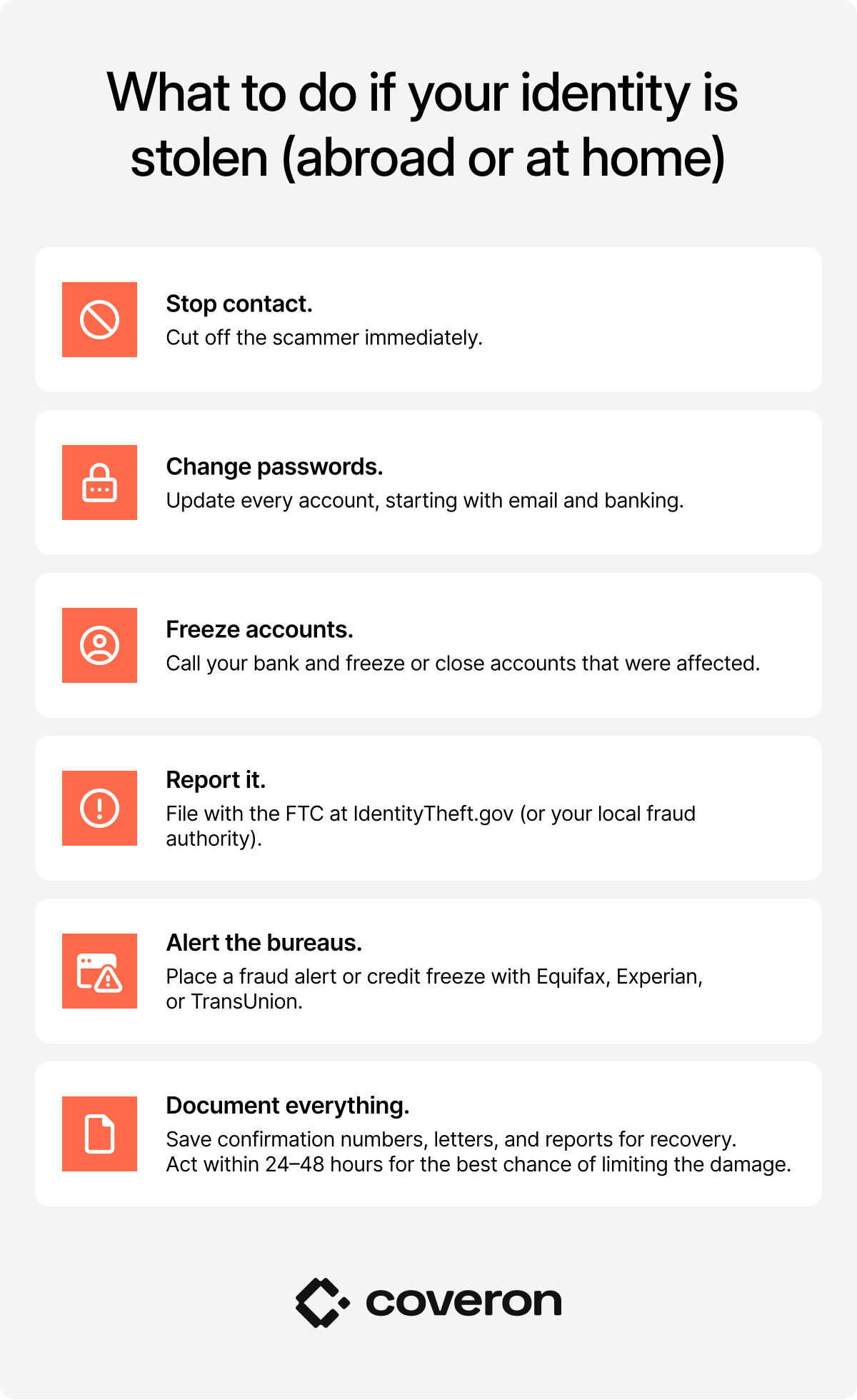
If you’re wondering what to do if your identity is stolen, the answer is to act quickly. If you suspect identity theft, it’s crucial to inform all the relevant authorities — from the Federal Trade Commission (FTC) to your bank — and freeze your bank account before scammers can steal all your money. Here’s a detailed breakdown of what to do if your ID is stolen and you are a victim of identity theft.
PRO TIP: Focus on the first 24 to 48 hours.
The first 24 to 48 hours matter most. Change your passwords, turn on multi-factor authentication everywhere you can, and call your bank. You should also freeze your credit with the three major credit reporting agencies, file reports with the FTC and local law enforcement agencies, and keep records of every call and confirmation number.
Stop interacting with the identity thief
If a scammer is still messaging or calling you, stop responding. Here’s what to do if you suspect identity theft:
- Don’t try to negotiate with identity thieves or expose them on your own. Every extra exchange gives them a chance to pull more information from you or pressure you into a mistake.
- Block the number or account and save the messages as evidence.
- Secure your accounts immediately.
Change passwords
Changing compromised passwords is the first step to take if you suspect identity theft. It can help you prevent account takeover and regain control of your online accounts. However, first make sure your device and connection are secure, especially in case malware was used for the identity theft. Change the password of your email, financial accounts, and any government service portals like SSA.gov if applicable. Never use the same password for different online services!
Freeze or close the accounts
Once your online accounts are secure, call your bank to report the suspected fraud and freeze your account. Though it’s likely the bank will contact you first (upon noticing suspicious activity in your account), calling your bank as soon as you suspect identity theft may prevent you from suffering financial identity theft altogether.
To report suspicious account activity to your bank, either call the bank’s customer service number or report the incident via the bank's official website. Some banks may also have a hotline dedicated to reporting cases of identity theft.
File a report with the Federal Trade Commission
If you're a US citizen, notify the FTC about identity theft right after securing your accounts. The FTC will create a report that helps you dispute fraudulent charges, remove incorrect info from your credit report, and provide evidence of the crime to creditors and institutions. In addition, the FTC can offer assistance in recovering lost funds and filing police reports. To report identity theft to the FTC, visit IdentityTheft.gov to file a report and receive a personalized recovery plan.
If you’re not a US citizen, you should report identity theft to the FTC equivalent in your country. For Australians, that can be done using the Australian Competition and Consumer Commission’s (ACCC) ScamWatch platform, while Canadians should contact the Canadian Anti-Fraud Centre (CAFC). UK citizens should report identity theft to Action Fraud, while EU residents should seek help from the local police’s cybercrime unit.
Place a fraud alert on a credit report
Placing a fraud alert on a credit report is a smart step when someone steals your identity. Doing so will alert creditors, in case malicious actors have already begun to apply for loans or withdraw funds using your bank account. With your alert, the creditors can then take extra steps before opening new accounts, preventing fraudulent accounts from appearing and damaging your credit score. To place a fraud alert, contact Equifax, TransUnion, or other reputable credit monitoring agencies in your country.
Report to the local police department
If you’re a US citizen, reporting identity theft to your local police may not be mandatory. However, if you live outside the US and your local police office has a cybercrime division, it’s best to contact it as soon as possible. Doing so may provide you with further guidance and steps on what to do to recover at least some of the lost assets. To report identity theft to your local police department, contact its non-emergency line or visit its website to file a report.
Recover your identity
Once you secure your accounts and file reports, depending on how the fraud occurred, you may need to:
- Dispute fraudulent accounts, transactions, or charges with banks, credit card issuers, lenders, and other affected companies.
- Replace a compromised Social Security card, driver’s license, or passport through the relevant government agency.
- Monitor your accounts and credit file closely for months afterward, since fraudulent activity can resurface long after the initial incident. Make sure to keep detailed records of every report you file.
- Seek legal help if the fraud is severe, if it involves large sums of money, or if a creditor refuses to remove fraudulent charges despite your documentation.
Once the immediate danger is contained, recovering your identity is often the hardest and slowest part of the process. It could take several days or weeks, and in some cases, it could take years. According to the National Taxpayer Advocate report,1 it takes the IRS around 19 months to resolve self-reported identity theft cases. In 2025, resolution times for these cases stretched up to almost two years on average, with around 316,000 cases reported to the Identity Theft Victim Assistance unit taking an average of 21 months to resolve.
Going through it alone adds real stress on top of the financial disruption, which is why it’s worth considering an identity theft protection service like Coveron to have a backup. With Coveron, you get a dedicated identity restoration case manager to walk you through the process. Moreover, Coveron’s identity theft recovery feature gives you up to $2M to cover qualifying identity theft recovery costs, including credit bureau reports, document replacement, application fees, legal fees, lost wages, and mental health counseling, subject to a $100 deductible. Beyond identity theft recovery, Coveron includes dark web monitoring and malware breach alerts, so you find out about threats before they escalate.
What to do if your identity is stolen in a foreign country
If your identity gets stolen while you’re in a foreign country, contacting the local authorities will not be enough. Here’s what to do if you think your identity has been stolen while abroad.
- Secure your accounts. Change your passwords right away and call your bank to freeze your accounts or cards, so no further transactions can go through while you’re away from home.
- Contact your embassy or consulate. They can help you replace a stolen passport and verify your identity for emergency travel documents. They can also point you toward local resources for reporting the crime.
- File a local police report. Even if it feels like a formality, you’ll likely need it as documentation for your bank, credit bureaus, or an insurance claim once you’re back home.
- Notify the relevant fraud authority for the region.
- In Australia, that’s the Australian Cyber Security Centre.
- In the UK, report to Action Fraud and CIFAS.
- In Canada, contact the Canadian Anti-Fraud Centre (CAFC) and the Canada Revenue Agency (CRA).
- In South Africa, notify the Southern African Fraud Prevention Service (SAFPS) or the South African Revenue Service (SARS).
- Across the EU, contact local police cybercrime units, national CERTs, or country-specific fraud bodies.
- In South America, reporting bodies vary by country, so start with local police and your embassy, then follow their guidance on next steps.
- Protect your accounts back home. Even if the theft happens overseas, notify the FTC or your bank as soon as you’re back online.
NOTE
If you’re a Coveron user and an American citizen who lives in the US, your identity theft recovery benefits apply wherever you are, as long as you subscribed before the identity theft occurred.
Warning signs of identity theft
Not sure if you’re a victim of identity theft? Spotting the warning signs early can help you act quickly:
-
Unfamiliar charges or withdrawals on your bank or credit card statements, including small transactions, that criminals may use to test a stolen card
-
Bills, missed payment notices, or collection notices for accounts you never opened
-
Bank statements or bills that suddenly stop arriving in the mail, which can mean someone redirected your mail
-
Credit applications denied for reasons you don’t recognize
-
A sudden, unexplained drop in your credit score
-
IRS notices about a tax return you didn’t file, or a rejected e-file, because a return was already submitted under your Social Security number
-
Login activity, password-reset emails, or account changes you don’t remember making
If you notice any of these signs, act fast. You can also learn more in our guide on the signs of identity theft.
How to protect yourself from identity theft
In 2025 alone, the FTC received 3 million fraud reports,2 resulting in $15.9 billion in losses. The FBI’s Internet Crime Complaint Center reported that it received 31,675 identity theft complaints in 2025.3 If you don’t want to become a part of these statistics, you need to learn to protect yourself from identity theft. Consider using these tips:
- Sign up for credit monitoring. A credit monitoring service will send alerts about any suspicious activity on your credit report, such as unauthorized new accounts or changes to your credit score. Many major services like Coveron or other LifeLock alternatives provide it as a common feature, so you’ll have a heads up if someone tries to steal money using your identity.
- Enable two-factor authentication (2FA). Using 2FA and other types of identity authentication for all sensitive accounts (email, banking, social media) adds an extra layer of protection and notifies you when someone’s trying to access your online accounts. It’s important to stress that you should never approve a suspicious 2FA request, especially if you didn’t try to sign in, complete the purchase, or otherwise trigger a 2FA pop-up.
- Never reuse passwords. Reusing passwords increases the risk of losing accounts in case of a phishing attack. Malicious actors are likely to try the same email and password to access your other online accounts to maximize the damage of the attack. So be sure to create strong, unique passwords and consider using a password manager to store and generate secure passwords.
- Closely monitor your bank and credit card statements. Regularly reviewing your bank and credit card statements is a healthy habit to have. It helps avoid suffering huge losses in case of identity theft, so make sure to check for any unauthorized transactions and immediately report any suspicious activity to your bank or card issuer.
- Place fraud alerts or credit freezes. Consider placing a fraud alert or a credit freeze on your credit file with the major credit bureaus. A fraud alert notifies lenders to take extra steps to verify your identity, while a credit freeze prevents anyone from accessing your credit report.
- Be careful when using public Wi-Fi. Public Wi-Fi can be a haven for malicious actors who look to intercept users’ online traffic. Avoid accessing sensitive accounts (like online banking) over public Wi-Fi networks. In addition, use a VPN to encrypt your internet connection and safeguard yourself online.
- Protect your Social Security number (SSN). Keep your SSN card in a safe place and avoid sharing your SSN unless absolutely necessary. Be extremely cautious of unsolicited requests for your SSN, especially via email or phone, and always independently verify the legitimacy of the request with the organization before providing it. Additionally, make sure to learn what to do if someone has your Social Security number.
- Be cautious of phishing scams. Be wary of unsolicited emails, messages, or phone calls asking for personal information. Always verify the source before clicking on links or sharing sensitive data.
- Review your credit report regularly. Request a free copy of your credit report from the three major credit bureaus — Experian, Equifax, or TransUnion. Each bureau provides one free report a year, so you can request three annually at annualcreditreport.com website). When you get your report, check for any inaccuracies or signs of fraud and learn how you can spot identity theft by looking at the personal section of your credit report.
- Consider cleaning up your digital footprint. Limiting how much personal data is publicly available makes it harder for criminals to misuse your information. Learn how to delete yourself from the internet to reduce exposure and strengthen your privacy.
- Use Coveron. Consider investing in additional identity theft protection services, such as Coveron. They can offer you assistance in identity theft recovery and additional measures to monitor your sensitive data. If you use Coveron, you can also enjoy features such as dark web monitoring and actionable security alerts, designed to inform you and offer assistance as soon as breached data appears online.
Get notified and act immediately.
30-day money-back guarantee
FAQ
References
1 National Taxpayer Advocate (2025). Annual report to Congress. IRS. https://www.irs.gov/pub/irs-access/p2104c_accessible.pdf opens in a new tab
2 FTC (2026). FTC Testifies before the Joint Economic Committee on Agency’s Efforts to Combat Fraud. https://www.ftc.gov/news-events/news/press-releases/2026/03/ftc-testifies-joint-economic-committee-agencys-efforts-combat-fraud opens in a new tab
3 Internet Crime Complaint Center (2025). Federal Bureau of Investigation Internet Crime Report. FTB. https://www.ic3.gov/AnnualReport/Reports/2025_IC3Report.pdf opens in a new tab